transferum
Transferum




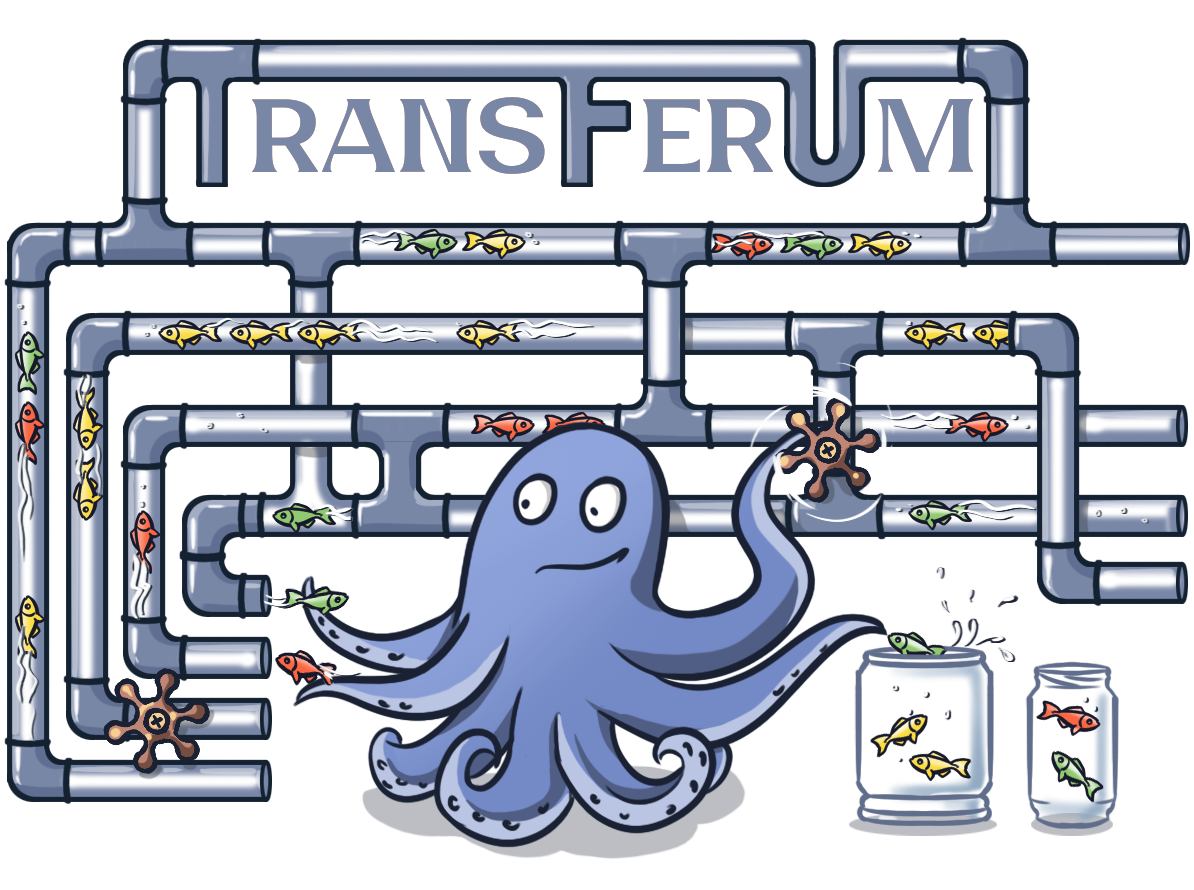
A language for describing interactions between components.
Type-safe primitives — transfers (nodes), bridges (edges), builders (chain constructors), and operators (data transformers) — compose into interaction graphs with compile-time-checked contracts.
Table of Contents
- Why Transferum?
- Domain-Specific Applications
- Comparison with Alternatives
- Installation & Import
- Core Concepts
- Transfers
- Transfer Comparison Table
- PushChannelTransfer
- DelayedPushChannelTransfer
- DebounceTransfer
- ThrottleTransfer
- PushStoredChannelTransfer
- BufferTransfer
- ManualBufferTransfer
- ManualFlowTransfer
- GateTransfer
- MergeTransfer
- SplitTransfer
- PollingSourceTransfer
- PollingProxyTransfer
- PollingFlowTransfer
- IdlePollingTransfer
- ChannelTransfer
- StoredChannelTransfer
- SinkTransfer
- WriteTransfer
- ReadTransfer
- ConvertTransfer
- ConditionTransfer
- DisplaceTransfer
- UniversalCompositeTransfer
- Async Transfer Comparison Table
- Async Transfers
- Backpressure
- Operators
- Storages
- Tickers
- Helpers
- Bridges
- Pipeline Builders
- Factories
- Utilities
- Guards
- Types
- Configurations
- Running Tests
- License
Why Transferum?
Problems It Solves
As data flows grow in complexity, connecting heterogeneous sources becomes a major bottleneck. Mixing push-based streams, pull-based APIs, polling loops, and async operations demands endless bespoke glue code, and this integration cost compounds with every new stage.
Transferum addresses the structural issues that emerge at scale:
- No unified contract between stages — connecting a subscribable source to a pushable sink, a pullable buffer to a polling proxy, or a sync stream to an async consumer shouldn't require hand-written adapters every time.
- Type erosion across boundaries — as data passes through transformation, filtering, and async stages, input/output types are lost. Mismatches surface at runtime, not at compile time.
- Sync/async impedance mismatch — mixing synchronous reactive streams with async operations typically forces a full migration to one model or manual bridging at every boundary.
- Flow control as an afterthought — gating, routing, rate limiting, and fallback behavior are scattered across conditional flags and ad-hoc timers rather than composed from reusable primitives.
- Fragmented lifecycle management — subscriptions, timers, and intermediate nodes are cleaned up inconsistently. A uniform
destroy()contract makes resource ownership explicit and leaks detectable.
Transferum provides composable, type-safe building blocks with a uniform capability system. You declare what each stage does (push, pull, transform, filter, poll) — the library handles how data moves between stages, including sync/async bridging, flow control, and resource cleanup.
Not a stream library — a data transfer graph library. Unlike RxJS, where everything is an
Observableand composition happens inside a single object, Transferum treats transfers as nodes and bridges as edges in a data transfer graph.linkTransfersconnects nodes by inspecting their capability contracts — not their class names. Builders assemble subgraphs fluently. Operators are local graph transformations. This makes Transferum architecturally closer to dataflow systems and component graphs than to classical reactive stream libraries.
Transfer ──── Bridge ──── Transfer
\ │
\ │
─────── Bridge ──── Transfer
This is a graph.
Key Benefits
| Benefit | How |
|---|---|
| Type-safe pipelines | Each transfer and operator carries its input/output types. Builders enforce type compatibility at compile time — a mismatch is a compile error, not a runtime crash. |
| Uniform capability model | Every transfer declares its capabilities via flags (isPushable, isSubscribable, isGate, …). linkTransfers automatically selects the correct wiring strategy — no manual glue code. Flags also define the transfer's TypeScript interface at compile time — methods like push() or subscribe() are type-guaranteed, not runtime-guessed (see Capability Flags System). |
| Sync + async in one system | Sync and async transfers coexist. linkTransfers prefers sync when possible and falls back to async strategies when needed. No separate "async world." |
| Composable architecture | Transfers link into chains, bridges connect chains with gate control, builders assemble chains fluently, operators transform data — all orthogonal and reusable. |
| Explicit lifecycle | Every resource has an explicit cleanup method — destroy() for transfers, bridges, and subscription managers; stop() for tickers; unsubscribe() for subscriptions. Builders track owned resources and clean them up in one call. No leaked timers or subscriptions. |
| Reactive by default, pull when needed | Most transfers are subscribable (push-based reactivity). Polling transfers add pull-based data acquisition on the same foundation. Use the right model per stage without switching libraries. |
| Local, fail-safe error handling | Errors are local to each transfer — one stage's failure doesn't kill the pipeline. With onError — suppressed, stream continues. Without — visible (exception/rejection), and polling stops (no zombie tickers). Per-stage granularity (onAcceptError/onEmitError, onDestroyError). Typed ErrorHandler<TSource> passes the transfer instance. No silent swallowing. |
| Undefined suppression | undefined never propagates through the chain of transfers — it means "no data", not "empty value." Use null as an explicit empty marker when needed. This eliminates an entire class of null-check bugs in downstream consumers. |
| Built-in backpressure | Four async transfers (AsyncSinkTransfer, AsyncWriteTransfer, AsyncConvertTransfer, AsyncConditionTransfer) support optional maxConcurrency, bufferSize, and onBufferOverflow — limiting parallel async operations, queuing excess data, and handling overflow gracefully. Defaults are backward-compatible (unlimited). See Backpressure. |
| Ordered async execution | AsyncSinkTransfer and AsyncWriteTransfer support optional ordered: true — callback/write invocations are executed sequentially in data-arrival order, regardless of their async duration. AsyncConvertTransfer and AsyncConditionTransfer automatically enforce ordered emission when maxConcurrency > 1 via an internal Sequence Guard (no config needed). See Backpressure. |
| No god-objects, no utility sprawl | BaseTransfer stays minimal — only capability declarations, no logic. Each transfer class models exactly one behavioral concept (buffering, gating, merging, polling...). No central object knows about every other component. Complexity is concentrated in the type layer; runtime code stays compact and readable. |
| Pluggable linking | LinkStrategyInterface lets you override how transfers are wired together — implement link() for custom logic (logging, validation, serialization, inter-process bridging) and inject it into CompositeTransferBuilder.start(transfer, { linkStrategy }). The default DefaultLinkStrategy delegates to linkTransfers() — zero-config for existing code, plug-and-play for custom needs. See Linking. |
Use Cases
Real-time UI updates from API polling
import {
CompositeTransferBuilder, createAsyncPollingSourceTransfer, createConvertTransfer,
createMapOperator, createPushStoredChannelTransfer,
} from 'transferum';
// Poll an API every 5 seconds, transform the response, update subscribers
const polling = createAsyncPollingSourceTransfer<ServerState>({
fetcher: async (): Promise<ServerState> => await fetchApi('/api/state'),
interval: 5000,
activated: true,
});
const pipeline = CompositeTransferBuilder
.start(polling)
.to(createConvertTransfer<ServerState, ViewModel>({
operator: createMapOperator((state) => toViewModel(state)),
}))
.finish(createPushStoredChannelTransfer<ViewModel>());
pipeline.subscribe((vm) => renderUI(vm));
Debounced user input with async validation
import {
CompositeTransferBuilder, createPushStoredChannelTransfer, createDebounceTransfer, createAsyncConditionTransfer,
createAsyncConvertTransfer, createAsyncSinkTransfer, createAsyncMapOperator,
} from 'transferum';
// Debounce input → validate → transform → send to async sink
const input = createPushStoredChannelTransfer<string>();
const pipeline = CompositeTransferBuilder
.start(input)
.to(createDebounceTransfer<string>({ delay: 300 }))
.to(createAsyncConditionTransfer<string>({ shouldAccept: async (s) => s.length > 0 }))
.to(createAsyncConvertTransfer<string, ValidationResult>({
operator: createAsyncMapOperator(async (s) => await validate(s)),
}), { onLinkError: (e) => console.error(e) })
.finish(createAsyncSinkTransfer<ValidationResult>({
callback: async (result) => await saveResult(result),
}), { onLinkError: (e) => console.error(e) });
input.push('user@example.com'); // debounced → validated → saved
Merging multiple data sources into a single view
import { createAsyncPollingSourceTransfer, createPushStoredChannelTransfer, createMergeTransfer } from 'transferum';
// Merge multiple sensor streams into one (all sources must have the same type)
const tempSensor = createAsyncPollingSourceTransfer<SensorData>({
fetcher: () => Promise.resolve({ sensor: 'temperature', value: 25 }),
interval: 1000,
activated: true,
});
const humiditySensor = createAsyncPollingSourceTransfer<SensorData>({
fetcher: () => Promise.resolve({ sensor: 'humidity', value: 55 }),
interval: 1000,
activated: true,
});
const merge = createMergeTransfer<SensorData>({ sources: [tempSensor, humiditySensor] });
merge.subscribe((data) => updateDashboard(data)); // receives data from both sensors
Conditional routing with bridges
import { createBridgeSelector, createPassBridge } from 'transferum';
// Route data to different processing pipelines based on a selector
const fastBridge = createPassBridge({ source, target: fastPipeline, activated: false });
const slowBridge = createPassBridge({ source, target: slowPipeline, activated: false });
const router = createBridgeSelector({
bridges: { fast: fastBridge, slow: slowBridge },
initialKey: 'fast',
activated: true,
owned: false,
});
// Switch route at runtime
router.select('slow');
Idle fallback polling
import { createAsyncIdlePollingTransfer } from 'transferum';
// When sensor push API stops interacting, fall back to polling for fresh data
const channel = createAsyncIdlePollingTransfer<SensorState>({
fetcher: async () => await fetchSensorState(),
timeout: 10000, // 10 s of inactivity → start polling
interval: 2000, // poll every 2 s
activated: true,
onError: (e, currentChannel) => {
console.warn('Cannot get sensor state');
showAlert(currentChannel);
},
});
channel.subscribe((item) => appendToChart(item));
// Sensor pushes items (e.g. by websocket) → real-time. User goes idle → automatic polling kicks in.
channel.push({ temperature: 25 });
Async data pipeline with storage
import {
CompositeTransferBuilder, createPushStoredChannelTransfer, createAsyncConvertTransfer, createAsyncMapOperator,
} from 'transferum';
// Push data → async transform → notify subscribers
const source = createPushStoredChannelTransfer<RawData>();
const pipeline = CompositeTransferBuilder
.start(source)
.to(createAsyncConvertTransfer<RawData, ProcessedData>({
operator: createAsyncMapOperator(async (raw) => await process(raw)),
}), { onLinkError: (e) => console.error(e) })
.finish(createPushStoredChannelTransfer<ProcessedData>(), {
onLinkError: (e) => console.error(e),
});
pipeline.subscribe((data) => console.log('processed data', data));
source.push(rawData); // → async transformation → processed data
Broadcast to multiple consumers
import { createPushStoredChannelTransfer, createSplitTransfer, createSinkTransfer, createWriteTransfer, linkTransfers } from 'transferum';
// One source → multiple independent consumers
const source = createPushStoredChannelTransfer<Telemetry>();
const split = createSplitTransfer<Telemetry>({
targets: [
createSinkTransfer({ callback: (t) => logTelemetry(t) }),
createSinkTransfer({ callback: (t) => updateChart(t) }),
createWriteTransfer({ flow: telemetryStorage }),
],
});
linkTransfers(source, split);
source.push(telemetry); // → logged, charted, and stored simultaneously
Domain-Specific Applications
Transferum is designed for building complex, predictable data processing systems across various domains:
Game Development
Input Processing Pipeline
Collect events from keyboard → filter (e.g., DebounceTransfer to prevent spam) → transform into game commands → route to appropriate systems.
import {
createDebounceTransfer, createConvertTransfer, createMapOperator,
createBridgeSelector, createPassBridge,
} from 'transferum';
// Raw input source (for keystrokes)
// Delays handling by 16ms (~1 frame at 60 FPS) to debounce rapid inputs
const rawInputSource = createDebounceTransfer<KeyboardEvent>({ delay: 16 });
// Converter: transforms raw KeyboardEvent into a simple string action
const inputConverter = createConvertTransfer<KeyboardEvent, string>({
operator: createMapOperator((event) => event.code), // Extracts the key code
});
// Target subsystems (consumers that process the final commands)
const carSystem = { push: (cmd: string) => console.log(`🚗 Car executing: ${cmd}`) };
const planeSystem = { push: (cmd: string) => console.log(`✈️ Plane executing: ${cmd}`) };
const menuSystem = { push: (cmd: string) => console.log(`📋 Menu processing: ${cmd}`) };
// Router: manages which input context/subsystem is currently active
const gameplayRouter = createBridgeSelector({
bridges: {
driving: createPassBridge({ source: inputConverter, target: carSystem }),
flying: createPassBridge({ source: inputConverter, target: planeSystem }),
ui: createPassBridge({ source: inputConverter, target: menuSystem }),
},
initialKey: 'driving', // The player starts inside a car by default
activated: true,
owned: true,
});
// Pipe data from the raw source to the converter (proper subscription without loops)
rawInputSource.subscribe((event) => inputConverter.push(event));
// Gameplay Simulation:
async function runSimulation() {
// 1. Player presses 'KeyW' while driving the car
rawInputSource.push(new KeyboardEvent('keydown', { code: 'KeyW' }));
// Expected Output after debounce: 🚗 Car executing: KeyW
// Wait for debounce timer (16ms) to fire and deliver data to carSystem
await sleep(20);
// 2. Player boards a plane — switch the control context
gameplayRouter.select('flying');
// 3. Player presses the exact same 'KeyW' key
rawInputSource.push(new KeyboardEvent('keydown', { code: 'KeyW' }));
// Expected Output after debounce: ✈️ Plane executing: KeyW
// Wait for the second debounce timer to fire
await sleep(20);
}
runSimulation();
Particle & Sound Effects
Use BridgeMultiSelector to activate multiple effects simultaneously on events (explosion, hit).
import { createBridgeMultiSelector, createPassBridge } from 'transferum';
const effects = createBridgeMultiSelector({
bridges: {
explosion: createPassBridge({ source: trigger, target: particleSystem, activated: false }),
sound: createPassBridge({ source: trigger, target: audioSystem, activated: false }),
shake: createPassBridge({ source: trigger, target: cameraShake, activated: false }),
},
initialKeys: [],
activated: true,
owned: true,
});
// On explosion event
effects.check('explosion');
effects.check('sound');
effects.check('shake');
IoT & Automation
Sensor Data Aggregation
Read data from multiple sensors (temperature, humidity, motion) via AsyncPollingSourceTransfer → filter (ConditionTransfer) → aggregate → send to cloud or local storage.
import {
CompositeTransferBuilder, createAsyncPollingSourceTransfer, createMergeTransfer,
createConditionTransfer, createAsyncWriteTransfer,
} from 'transferum';
const sensor1 = createAsyncPollingSourceTransfer<SensorData>({
fetcher: () => Promise.resolve({ temperature: 25, humidity: 50 }),
interval: 50,
activated: true,
});
const sensor2 = createAsyncPollingSourceTransfer<SensorData>({
fetcher: () => Promise.resolve({ temperature: 26, humidity: 55 }),
interval: 50,
activated: true,
});
const aggregator = createMergeTransfer<SensorData>({
sources: [sensor1, sensor2],
});
const pipeline = CompositeTransferBuilder
.start(aggregator)
.to(createConditionTransfer<SensorData>({ shouldAccept: (d) => d.temperature > 0 && d.humidity >= 0 }))
.finish(createAsyncWriteTransfer<SensorData>({ flow: cloudStorage }));
Device Control
Process commands from users or external systems → route to specific actuators (BridgeSelector) → receive feedback.
import { createBridgeSelector, createPassBridge } from 'transferum';
const commandRouter = createBridgeSelector({
bridges: {
light: createPassBridge({ source: commandChannel, target: lightController, activated: false }),
thermostat: createPassBridge({ source: commandChannel, target: thermostatController, activated: false }),
lock: createPassBridge({ source: commandChannel, target: lockController, activated: false }),
},
initialKey: 'light',
activated: true,
owned: true,
});
commandRouter.select('thermostat'); // switch to thermostat control
Monitoring & Alerts
Poll device temperature via AsyncPollingSourceTransfer → filter by threshold (ConditionTransfer) → throttle alerts (ThrottleTransfer) → transform into alert (ConvertTransfer) → send notification.
import {
CompositeTransferBuilder, createConditionTransfer, createThrottleTransfer,
createConvertTransfer, createMapOperator, createAsyncPollingSourceTransfer,
} from 'transferum';
const TEMPERATURE_THRESHOLD = 95;
const tempMonitor = createAsyncPollingSourceTransfer<number>({
fetcher: async () => await readTemperature(),
interval: 1000,
activated: true,
});
const alertPipeline = CompositeTransferBuilder
.start(tempMonitor)
.to(createConditionTransfer<number>({ shouldAccept: (temp) => temp > TEMPERATURE_THRESHOLD }))
.to(createThrottleTransfer<number>({ interval: 5000 }))
.finish(createConvertTransfer<number, Alert>({ operator: createMapOperator((temp): Alert => ({ type: 'HIGH_TEMP', value: temp })) }));
alertPipeline.subscribe((alert) => sendNotification(alert));
UI/UX Applications
Reactive Forms
Process user input in form fields → DebounceTransfer for autosave or live search → validate (ConditionTransfer) → async transform (MapOperator) → store results.
import {
CompositeTransferBuilder, createDebounceTransfer, createAsyncConditionTransfer,
createAsyncConvertTransfer, createPushStoredChannelTransfer, createAsyncMapOperator,
} from 'transferum';
const searchInput = createDebounceTransfer<string>({ delay: 300 });
const pipeline = CompositeTransferBuilder
.start(searchInput)
.to(createAsyncConditionTransfer<string>({ shouldAccept: async (s) => s.length >= 3 }))
.to(createAsyncConvertTransfer<string, SearchResult[]>({
operator: createAsyncMapOperator(async (query) => await searchAPI(query)),
}), { onLinkError: (e) => console.error(e) })
.finish(createPushStoredChannelTransfer<SearchResult[]>(), {
onLinkError: (e) => console.error(e),
});
pipeline.subscribe((results) => renderSuggestions(results));
searchInput.push('user query');
Monitoring & Logging Systems
Metrics Collection
Collect metrics from various sources (server logs, client events) → filter → transform → send to multiple monitoring systems (BridgeMultiSelector for Prometheus, ELK, Sentry simultaneously).
import { createPushStoredChannelTransfer, createBridgeMultiSelector, createPassBridge } from 'transferum';
const metricsChannel = createPushStoredChannelTransfer<Metric>();
const destinations = createBridgeMultiSelector({
bridges: {
prometheus: createPassBridge({ source: metricsChannel, target: prometheusWriter, activated: false }),
elk: createPassBridge({ source: metricsChannel, target: elkWriter, activated: false }),
sentry: createPassBridge({ source: metricsChannel, target: sentryWriter, activated: false }),
},
initialKeys: ['prometheus', 'elk'],
activated: true,
owned: true,
});
metricsChannel.push({ name: 'request_latency', value: 150 });
Financial Applications
Stock Market Data Processing
Receive streaming quotes → calculate indicators (MapOperator) → filter by conditions (ConditionTransfer) → transform into trading signals (ConvertTransfer) → execute trades.
import {
CompositeTransferBuilder, createPushChannelTransfer, createPushStoredChannelTransfer, createConvertTransfer,
createConditionTransfer, createAsyncSinkTransfer, createMapOperator,
} from 'transferum';
const quoteStream = createPushChannelTransfer<Quote[]>();
const thresholdChannel = createPushStoredChannelTransfer<number>({ initialValue: 100 });
const indicatorPipeline = CompositeTransferBuilder
.start(quoteStream)
.to(createConvertTransfer<Quote[], TechnicalIndicator>({
operator: createMapOperator((quotes): TechnicalIndicator => ({
value: quotes.reduce((sum, q) => sum + q.price, 0),
symbols: quotes.map((q) => q.symbol),
threshold: thresholdChannel.pull() ?? 0,
})),
}))
.to(createConditionTransfer<TechnicalIndicator>({ shouldAccept: (ind) => ind.value > ind.threshold }))
.to(createConvertTransfer<TechnicalIndicator, TradingSignal>({
operator: createMapOperator((ind) => ({
action: 'BUY',
symbols: ind.symbols,
targetPrice: ind.value,
})),
}))
.finish(createAsyncSinkTransfer<TradingSignal>({
callback: async (signal) => await executeTrade(signal),
}), { onLinkError: (e) => console.error(e) });
quoteStream.push([{ symbol: 'AAPL', price: 150, timestamp: Date.now() }]);
thresholdChannel.push(200);
Portfolio Management
Use BridgeSelector to switch between different strategies or data sources.
import { createBridgeSelector, createPassBridge } from 'transferum';
const strategyRouter = createBridgeSelector({
bridges: {
conservative: createPassBridge({ source: marketData, target: conservativeStrategy, activated: false }),
aggressive: createPassBridge({ source: marketData, target: aggressiveStrategy, activated: false }),
balanced: createPassBridge({ source: marketData, target: balancedStrategy, activated: true }),
},
initialKey: 'balanced',
activated: true,
owned: true,
});
// Switch strategy based on market conditions
if (marketVolatility > HIGH_THRESHOLD) {
strategyRouter.select('conservative');
}
Comparison with Alternatives
Transferum exists in a rich ecosystem of reactive and stream-processing libraries. This section compares it with popular alternatives to help you make an informed choice.
Transferum vs RxJS
RxJS is the most widely adopted reactive programming library for JavaScript/TypeScript.
| Aspect | Transferum | RxJS |
|---|---|---|
| Bundle size | ~15 KB minified | ~35 KB minified (full), <5 KB (selective imports) |
| Dependencies | Zero | Zero (v7+) |
| Learning curve | Moderate — explicit primitives | Steep — 100+ operators, complex concepts |
| Type inference | Strong — tuple-based pipeline types | Strong — but complex generic chains |
| Sync/Async unify | Built-in — linkTransfers handles both |
Manual — from(), toPromise(), firstValueFrom() |
| Pull-based | Native — Pullable, PollingProxy |
Limited — mostly push-based |
| Gate/Flow control | Built-in — GateTransfer, BridgeSelector, DisplaceTransfer |
Manual — takeUntil(), switchMap(), subjects |
| Resource cleanup | Explicit — destroy() on every transfer |
Subscription-based — subscription.unsubscribe() |
| Error handling | Local, non-fatal — onError per transfer, fail-safe polling, typed source |
Stream-level — catchError(), retry(), errors terminate stream |
| Undefined handling | Suppressed — undefined never propagates |
Propagated — undefined is a valid value |
| Operators | ~10 pure operators (stateless transforms only) | 100+ operators (creation, transformation, filtering, combination, utility) |
| Flow control / Rate limiting | Built-in transfers — DebounceTransfer, ThrottleTransfer, BufferTransfer, GateTransfer (with explicit lifecycle) |
Built-in operators — throttle(), buffer(), sample() (state lives in subscription) |
| Operator-equivalent coverage | Many RxJS operators are transfers: debounceTime→DebounceTransfer, filter→ConditionTransfer, merge→MergeTransfer, share→SplitTransfer, takeUntil→GateTransfer, delay→DelayedPushChannelTransfer, switchMap→DisplaceTransfer |
All flow control is operator-based — no separate node lifecycle |
| Testing | Simple — fake timers, direct method calls | Complex — TestScheduler, marble diagrams |
| Community | Small — single maintainer | Large — Google, widespread adoption |
Key differences:
- Architecture: RxJS uses
Observable+Operator+Subscriptionmodel. Transferum usesTransfer+Bridge+Builderwith capability flags. - Models, not abstractions: RxJS builds around a single abstraction (
Observable) that serves as source, connection, and handler simultaneously. Transferum builds around distinct models — transfers are nodes, bridges are edges, operators are transforms. Each has a clear role; none tries to be all of them. - Composability: RxJS operators are functions that transform observables. Transferum transfers are objects that can be linked via
linkTransfers()automatically. - Error handling: RxJS errors propagate through the stream and terminate it unless caught with
catchError()/retry(). Transferum errors are local to each transfer — withonError, suppressed and the stream continues; without, the error is visible (exception/rejection) and polling stops (fail-safe). One stage's failure doesn't kill the pipeline. See Error Handling. - Scheduling: RxJS has
Schedulerabstraction (async, asyncSchedule, animationFrame). Transferum hasTicker(RAFTicker, IntervalTicker) for polling.
Code comparison — Conditional routing with runtime switching:
// RxJS
import { Subject, filter, mergeMap, from, catchError, EMPTY, Subscription } from 'rxjs';
const transports = {
sentry: {
level: 'ERROR',
send: (l) => sentryAPI.send(l),
},
elk: {
level: 'WARN',
send: (l) => elkAPI.send(l),
},
prometheus: {
level: 'INFO',
send: (l) => prometheusAPI.send(l),
},
};
// Subscription infrastructure
const source$ = new Subject<LogEntry>();
const subscriptions = new Map<string, Subscription>();
function activateRoute(key: string) {
if (subscriptions.has(key)) return;
const config = transports[key];
if (!config) return; // Guard against unknown keys
const sub = source$.pipe(
// Filter logs by level from config
filter((l) => l.level === config.level),
// Wrap async send in Observable, swallow errors to keep source$ alive
mergeMap((l) =>
from(config.send(l)).pipe(
catchError((e) => {
console.error(`Error in ${key}:`, e);
return EMPTY;
})
)
)
).subscribe();
subscriptions.set(key, sub);
}
function deactivateRoute(key: string) {
subscriptions.get(key)?.unsubscribe();
subscriptions.delete(key);
}
// Initial routes
activateRoute('sentry');
activateRoute('elk');
activateRoute('prometheus');
// Runtime: leave only Sentry and Prometheus
deactivateRoute('elk');
// Activate / deactivate single route
activateRoute('elk');
deactivateRoute('elk');
// Transferum
import {
createBridgeMultiSelector, createPassBridge, createPushStoredChannelTransfer,
createConditionTransfer, createAsyncSinkTransfer, createSplitTransfer, linkTransfers,
} from 'transferum';
const source = createPushStoredChannelTransfer<LogEntry>();
const sentryFilter = createConditionTransfer<LogEntry>({ shouldAccept: (l) => l.level === 'ERROR' });
const elkFilter = createConditionTransfer<LogEntry>({ shouldAccept: (l) => l.level === 'WARN' });
const prometheusFilter = createConditionTransfer<LogEntry>({ shouldAccept: (l) => l.level === 'INFO' });
linkTransfers(source, createSplitTransfer<LogEntry>({ targets: [sentryFilter, elkFilter, prometheusFilter] }));
const routes = createBridgeMultiSelector({
bridges: {
sentry: createPassBridge({
source: sentryFilter,
target: createAsyncSinkTransfer<LogEntry>({ callback: async (l) => sentryAPI.send(l), onError: (e) => console.error(e) }),
activated: false,
}),
elk: createPassBridge({
source: elkFilter,
target: createAsyncSinkTransfer<LogEntry>({ callback: async (l) => elkAPI.send(l), onError: (e) => console.error(e) }),
activated: false,
}),
prometheus: createPassBridge({
source: prometheusFilter,
target: createAsyncSinkTransfer<LogEntry>({ callback: async (l) => prometheusAPI.send(l), onError: (e) => console.error(e) }),
activated: false,
}),
},
initialKeys: ['sentry', 'elk', 'prometheus'],
activated: true,
owned: true,
});
// Runtime: leave only Sentry and Prometheus
routes.select(['sentry', 'prometheus']);
// Activate / deactivate single route
routes.check('elk');
routes.uncheck('elk');
RxJS handles routing via manual subscription management — a Map to track active subscriptions and explicit
activateRoute/deactivateRoute functions. Transferum's BridgeMultiSelector is a first-class routing object:
declarative bridge list, built-in subscription management (owned: true), and select() / check() / uncheck()
to switch routes at runtime.
Code comparison — Debounced search with error handling and empty-result suppression:
The API call can fail — errors must be logged without killing the stream. Empty result sets must not reach the renderer.
// RxJS
import { fromEvent, from, EMPTY } from 'rxjs';
import { debounceTime, switchMap, filter, map, catchError } from 'rxjs/operators';
fromEvent(searchInput, 'input')
.pipe(
debounceTime(300),
map((e: Event) => (e.target as HTMLInputElement).value),
filter(query => query.length >= 3),
switchMap(query =>
from(searchAPI(query)).pipe(
catchError(e => {
console.error(e);
return EMPTY;
})
)
),
filter(results => results.length > 0)
)
.subscribe(results => render(results));
// Transferum
import {
CompositeTransferBuilder, createPushChannelTransfer, createDebounceTransfer, createConditionTransfer,
createDisplaceTransfer, createAsyncConvertTransfer, createAsyncMapOperator, createSinkTransfer,
} from 'transferum';
const input = createPushChannelTransfer<string>();
const pipeline = CompositeTransferBuilder
.start(input)
.to(createDebounceTransfer<string>({ delay: 300 }))
.to(createConditionTransfer<string>({ shouldAccept: q => q.length >= 3 }))
.to(createDisplaceTransfer<string, SearchResult[]>({
factory: () => createAsyncConvertTransfer<string, SearchResult[]>({
operator: createAsyncMapOperator(async (query) => await searchAPI(query)),
onError: (e) => console.error(e),
}),
}))
.to(createConditionTransfer<SearchResult[]>({ shouldAccept: results => results.length > 0 }))
.finish(createSinkTransfer<SearchResult[]>({
callback: results => render(results),
}), { owned: true });
input.push(query); // manually push, or integrate with DOM event
Transferum vs Most.js
Most.js is a lightweight, high-performance FRP library.
| Aspect | Transferum | Most.js |
|---|---|---|
| Bundle size | ~15 KB | ~7 KB |
| Status | Active (2026) | Maintenance mode (2020+) |
| Async support | Built-in async transfers | Native async event loop |
| Pull-based | Yes — Pullable, PollingProxy |
No — push-only |
| TypeScript | First-class, strict types | Community typings |
| Operators | ~10 (pure transforms; flow control via transfers) | ~40 |
Most.js excels in raw performance for push-based streams but lacks Transferum's pull-based primitives and unified sync/async model.
Transferum vs Bacon.js / Kefir
Bacon.js and Kefir are Functional Reactive Programming (FRP) libraries with Property (stateful) and EventStream (stateless) abstractions.
| Aspect | Transferum | Bacon.js / Kefir |
|---|---|---|
| State model | Explicit — ProxyReference<T> per transfer |
Implicit — Property holds state |
| Stream types | Capability flags (isSubscribable, isPullable) |
Two types: EventStream, Property |
| Error handling | Local, non-fatal — onError per transfer, fail-safe |
Error events terminate stream |
| Async | First-class async transfers | Via fromPromise() |
| Bundle size | ~15 KB | ~12 KB (Bacon), ~8 KB (Kefir) |
| Status | Active | Bacon: maintenance, Kefir: archived |
Transferum's capability flags provide more granularity than the two-type model, allowing fine-grained control over data flow mechanics. Unlike Bacon.js/Kefir's runtime-only EventStream / Property distinction, Transferum's flags are compile-time type literals — TypeScript knows which methods each transfer exposes without runtime checks.
Transferum vs Node Streams / WHATWG Streams
Node Streams and WHATWG Streams (the web standard) both address data piping through typed stream objects.
| Aspect | Transferum | Node Streams / WHATWG Streams |
|---|---|---|
| Type system | Capabilities are composable — mix push + pull + gate + poll in one type | 4 fixed roles (Readable / Writable / Duplex / Transform) — no composition of capabilities within a single stream |
| Model | Capabilities, not stream types | Fixed stream types — a new role means a new class |
| Push + Pull | Both first-class — isPushable / isPullable as flags |
Readable = pull-oriented, Writable = push-oriented |
| Gate / Routing | Built-in — GateTransfer, BridgeSelector |
Manual — pipe chains, no routing primitive |
| Error handling | Local, non-fatal — per-transfer onError |
Stream-level — errors propagate and can destroy stream |
| Lifecycle | Explicit destroy() on every transfer |
destroy() / cancel() — inconsistent across impls |
| TypeScript | First-class — computed interfaces from flags | Community typings (Node), limited generics (WHATWG) |
Node Streams and WHATWG Streams solve piping well, but they introduce a new stream type for each role (Readable, Writable, Duplex, Transform). Transferum introduces capabilities instead — a transfer declares what it can do via flags, and the type system computes the correct interface. Adding a new capability doesn't require a new stream class; it requires a new flag. This scales combinatorially better.
Quick Comparison Table
| Feature | Transferum | RxJS | Most.js | Bacon.js | Kefir | Node Streams | WHATWG Streams |
|---|---|---|---|---|---|---|---|
| Bundle size (minified) | ~15 KB | ~35 KB | ~7 KB | ~12 KB | ~8 KB | Built-in | Built-in |
| Dependencies | 0 | 0 | 0 | 0 | 0 | 0 | 0 |
| Pull-based | ✓ | ✗ | ✗ | ✗ | ✗ | ✓ (Readable) | ✓ (Readable) |
| Push-based | ✓ | ✓ | ✓ | ✓ | ✓ | ✓ (Writable) | ✓ (Writable) |
| Sync/Async unify | ✓ | Partial | Partial | Partial | Partial | Partial | Partial |
| Built-in polling | ✓ (Ticker) | ✗ (manual) | ✗ | ✗ | ✗ | ✗ | ✗ |
| Gate/Flow control | ✓ (GateTransfer, Bridge) | Manual | Manual | Manual | Manual | Manual | Manual |
| Error handling | Local, non-fatal, fail-safe | Stream-level (catchError, retry) |
Stream terminates | Stream terminates | Stream terminates | Stream-level | Stream-level |
| Undefined suppression | ✓ | ✗ | ✗ | ✗ | ✗ | ✗ | ✗ |
| Operators count | ~10 (pure transforms) | 100+ | ~40 | ~60 | ~50 | ~15 (Transform) | ~10 (Transform) |
| Flow-control as nodes | ✓ (transfers with lifecycle) | ✗ (operators only) | ✗ | ✗ | ✗ | ✗ | ✗ |
| TypeScript support | Excellent | Excellent | Good | Fair | Fair | Fair | Fair |
| Community size | Small | Very large | Medium | Small | Small | Large | Medium |
| Maintenance status | Active | Active | Maintenance | Maintenance | Archived | Active | Active |
When to Choose Transferum
Transferum is ideal for:
- TypeScript-first projects — Strict type inference. Capability flags are compile-time literals (
isPushable: true, notboolean), so TypeScript knows which methods each transfer exposes —push(),subscribe(),pull()are type-guaranteed without casts or runtime checks. - Mixed sync/async pipelines — Unified model without manual conversion.
- Pull-based data acquisition — Polling APIs, sensors, or storage with
PollingProxy. - Explicit flow control — Gates, bridges, and selectors for runtime routing.
- Resource-conscious environments — Smaller bundle than RxJS, zero dependencies.
- Resilient error handling — Local, non-fatal error handling: one stage's failure doesn't kill the pipeline, broken pollers stop (fail-safe), no silent swallowing. Per-stage granularity with typed
ErrorHandler<TSource>. - Undefined-free data flow —
undefinednever propagates through the chain — it means "no data," not "empty value," eliminating null-check defects in consumers. - Game development / IoT — Frame-aligned tickers, idle polling, sensor aggregation.
- Infrastructure libraries — Where components interact in multiple ways (push, pull, polling, trigger, read, write) and the interaction contract matters more than the data format.
- Integration layers — Connecting heterogeneous components or services where a typed, capability-based contract is more valuable than a uniform stream interface.
- Complex pipelines with heterogeneous nodes — Where different stages have fundamentally different capabilities (some push-only, some pull-only, some gated, some polling) and these differences should be statically checked, not discovered at runtime.
- Embedded DSLs — Where the library serves as a language for describing an interaction graph with compile-time safety.
Example fit: Real-time dashboard with API polling, debounced user input, conditional routing to multiple visualizations, and unified sync/async data flows.
When to Consider Alternatives
Consider RxJS if:
- You need operators not covered by Transferum's transfers: stream combinators (
combineLatest,zip,withLatestFrom), windowing (bufferCount,windowTime), or retry policies (retryWhen). Many common operators (debounceTime,throttleTime,filter,merge,delay,takeUntil,switchMap) have transfer equivalents — see the comparison table above. - Your team already has RxJS expertise.
- You need advanced scheduling (test scheduler, virtual time).
- You need complex stream combination operators (e.g., combining 5+ distinct data sources with intricate join logic).
- Community support and long-term stability are top priorities.
Consider Most.js if:
- Raw performance is the top priority.
- You need a small, push-only stream library.
- You don't need pull-based or polling primitives.
Consider Bacon.js (or maintaining Kefir) only if:
- You are working on a legacy codebase already locked into these specific FRP abstractions.
Consider Node Streams / WHATWG Streams if:
- You need the web standard or Node.js native streaming protocol for interop.
- Your pipeline is purely I/O-oriented (file, network, compression) and doesn't need push+pull+gate+poll in one system.
- You don't need compile-time capability guarantees.
Installation & Import
npm i transferum
All components are exported from a single entry point:
import {
// Transfers
PushChannelTransfer,
DelayedPushChannelTransfer,
DebounceTransfer,
ThrottleTransfer,
PushStoredChannelTransfer,
BufferTransfer,
ManualBufferTransfer,
ManualFlowTransfer,
GateTransfer,
MergeTransfer,
SplitTransfer,
PollingSourceTransfer,
PollingProxyTransfer,
PollingFlowTransfer,
IdlePollingTransfer,
ChannelTransfer,
StoredChannelTransfer,
SinkTransfer,
WriteTransfer,
ReadTransfer,
ConvertTransfer,
ConditionTransfer,
DisplaceTransfer,
UniversalCompositeTransfer,
// Async transfers
AsyncSinkTransfer,
AsyncWriteTransfer,
AsyncReadTransfer,
AsyncConvertTransfer,
AsyncConditionTransfer,
AsyncPollingSourceTransfer,
AsyncPollingProxyTransfer,
AsyncPollingFlowTransfer,
AsyncIdlePollingTransfer,
AsyncStoredChannelTransfer,
// Operators
TransparentOperator,
MapOperator,
FilterOperator,
ReducerOperator,
GuardOperator,
PipelineOperator,
// Async operators
AsyncMapOperator,
AsyncGuardOperator,
AsyncPipelineOperator,
// Storages
LatestStorage,
QueueStorage,
StackStorage,
// Tickers
RAFTicker,
IntervalTicker,
TickerInterface,
// Helpers
Subscriber,
SubscriptionManager,
StateSubscriptionManager,
ProxyReference,
DisposableSubscriberAdapter,
// Bridges
PassBridge,
TransformBridge,
TransferBridge,
BridgeAggregator,
BridgeSelector,
BridgeMultiSelector,
AsyncTransformBridge,
// Linking
DefaultLinkStrategy,
LinkStrategyInterface,
// Builders
InputPipelineBuilder,
OutputPipelineBuilder,
DuplexPipelineBuilder,
OperatorPipelineBuilder,
// Async builders
AsyncInputPipelineBuilder,
AsyncOutputPipelineBuilder,
AsyncDuplexPipelineBuilder,
AsyncOperatorPipelineBuilder,
// Factories
createPushChannelTransfer,
createDelayedPushChannelTransfer,
createDebounceTransfer,
createThrottleTransfer,
createPushStoredChannelTransfer,
createDefaultLinkStrategy,
// ... all create* functions (including createAsync*)
// Utilities
linkTransfers,
handleError,
// Guards
isPushable,
isPullable,
isSubscribable,
isPollingProxy,
isTriggerable,
isGate,
isAsyncPushable,
isAsyncPullable,
isAsyncPollingProxy,
isAsyncTriggerable,
} from 'transferum';
Core Concepts
Architectural Invariants
Transferum is built on a single idea:
Behavior can be described as a composition of independent capabilities that simultaneously determine the type, the implementation, and the rules of interaction.
Everything else — transfers, bridges, builders, operators — follows from this principle. They are its consequences, not the idea itself. The invariants below are the shape these consequences take in code.
One idea, one direction. A single concept — capability — flows through every layer of the library:
Capability flags
↓
Type system (computed interfaces)
↓
Transfer (declares capabilities, implements behavior)
↓
Bridge (inspects capabilities, wires transfers)
↓
Builder (assembles transfers, enforces type compatibility)Operators are not a separate layer — they are stateless transforms used inside transfers. Adding a new capability propagates automatically through all layers. Adding a new transfer class requires only declaring its flags — the type system,
linkTransfers, and builders adapt without changes.
The invariants:
| Invariant | What it means | Where enforced |
|---|---|---|
| Transfers don't know their neighbors | A transfer defines its own behavior (push, pull, subscribe, gate…) but never references, imports, or checks the class of another transfer. It doesn't know what's upstream or downstream — it only fulfills its own contract. | BaseTransfer and all descendants — no cross-references between transfer classes |
| Bridges don't know concrete implementations | A bridge inspects capability flags, never class names. There is no instanceof chain, no RTTI, no class-name switching. Any transfer with the right capabilities is bridgeable — including ones that don't exist yet. |
linkTransfers, LinkStrategyInterface, PassBridge, BridgeSelector, all bridge classes |
| Capabilities define the contract | Flags are the single source of truth. They determine the TypeScript interface (compile-time), the available methods (runtime), the linking strategy (linkTransfers), and the builder type compatibility. One piece of metadata, many readers. |
interfaces.ts, types.ts, linkTransfers, LinkStrategyInterface, builders |
BaseTransfer is minimal |
The base class contains only capability declarations — no state, no logic. State lives in BaseStateTransfer<T> (one level down). This prevents the god-object pattern where a base accumulates knowledge of all descendants. |
BaseTransfer class hierarchy |
| One class, one behavior | Each transfer models exactly one behavioral concept. There are no combinatorial mega-classes (BufferedStoredGateTransfer). Complex behavior emerges from composition, not from inheritance depth. |
All transfer classes |
| Operators are stateless transforms | Operators transform data (apply(input) → output) and hold no pipeline state. They live inside transfers (ConvertTransfer, TransformBridge), not as standalone pipeline nodes. The transfer owns the behavioral contract; the operator owns the data transformation. |
OperatorInterface, AsyncOperatorInterface |
destroy() is universal |
Every resource has an explicit cleanup path — destroy() for transfers, bridges, and subscription managers; stop() for tickers; unsubscribe() for subscriptions. Builders track owned resources and clean them up in one destroy() call. No resource lacks a cleanup path. |
DisposableInterface, all transfers, all bridges, builders; TickerInterface.stop() |
undefined never propagates |
undefined means "no data," not "empty value." It is suppressed at SubscriptionManager.sendState() — subscribers are never notified with undefined. Use null for explicit empty markers. |
SubscriptionManager, all transfers |
Why these matter. A new transfer, bridge, or operator that respects these invariants integrates without touching existing code — the architecture stays coherent as it grows.
Capability Flags System
Each transfer implements CommunicationContractInterface — a set of boolean flags. Each flag is both a runtime value and a compile-time guarantee: when a flag is true, the corresponding method is part of the transfer's TypeScript type — TypeScript knows it exists without any casts or runtime checks.
| Flag | Methods | Description |
|---|---|---|
isInput |
— | Can accept data from outside (acts as an input) |
isOutput |
— | Can yield data (acts as an output) |
isDuplex |
— | Both input and output simultaneously (isInput && isOutput) |
isPushable |
push(data) |
Data can be pushed into the transfer |
isPullable |
pull() |
Data can be read from the transfer |
isSubscribable |
subscribe(handler) |
The transfer can be subscribed to |
isTriggerable |
trigger() |
Has a manual emission trigger |
isGate |
activate() / deactivate() / toggle() / active / onStateChange(handler) |
Flow control (on/off) + state subscription |
isPollingSource |
— | Has internal source polling |
isPollingProxy |
setFetcher() / clearFetcher() |
Polls the previous node in the chain |
Asynchronous flags:
| Flag | Methods | Description |
|---|---|---|
isAsyncPushable |
asyncPush(data) |
Data can be pushed into the transfer asynchronously |
isAsyncPullable |
asyncPull() |
Data can be read from the transfer asynchronously |
isAsyncTriggerable |
asyncTrigger() |
Asynchronous manual emission trigger |
isAsyncPollingProxy |
setAsyncFetcher() / clearAsyncFetcher() |
Asynchronously polls the previous node in the chain |
isAsyncSubscribableandisAsyncPollingSourceare not required — subscription remains synchronous in all async transfers, andisPollingSourceis reused.
How flags become compile-time guarantees: In interfaces.ts, each flag has a corresponding interface that narrows the flag to the literal type true (not boolean) and extends the matching method contract. When a transfer class implements these interfaces, TypeScript guarantees the presence of the methods at compile time:
// Base contract — all flags are `boolean` (runtime-checkable)
interface CommunicationContractInterface {
readonly isPushable: boolean;
readonly isPullable: boolean;
readonly isSubscribable: boolean;
// …
}
// isPushable: true → push(data: T) is guaranteed to exist
interface PushableTransferInterface<T> extends PushableInterface<T>, BaseTransferInterface {
readonly isInput: true;
readonly isPushable: true; // → TypeScript guarantees push(data) exists
}
// isPullable: true → pull(): T | undefined is guaranteed to exist
interface PullableTransferInterface<T> extends PullableInterface<T>, BaseTransferInterface {
readonly isOutput: true;
readonly isPullable: true; // → TypeScript guarantees pull() exists
}
// isSubscribable: true → subscribe(handler) is guaranteed to exist
interface SubscribableTransferInterface<T> extends SubscribableInterface<T>, BaseTransferInterface {
readonly isOutput: true;
readonly isSubscribable: true; // → TypeScript guarantees subscribe(handler) exists
}
This means: if a transfer's type includes isPushable: true, you can call push() on it — TypeScript will not error. If the flag is absent (or false), the method is not on the type, and calling it is a compile error, not a runtime surprise.
This carries through to the type system in types.ts, where flags define entire transfer categories:
InputTransfer<T>— union of all interfaces withisInput: true(push, poll-proxy, gate, async-push, async-poll-proxy).OutputTransfer<T>— union of all interfaces withisOutput: true(pull, subscribe, gate, async-pull).DuplexTransfer<TIn, TOut>— intersection ofInputTransfer<TIn>&OutputTransfer<TOut>withisDuplex: true.Transfer<TIn, TOut, Features[]>— a computed type that resolves a list of feature flags into a concrete intersection of branded interfaces.CompositeInputTransfer/CompositeOutputTransfer/CompositeDuplexTransfer— builder-produced types that expose only the capabilities of the underlying transfers, with optionaltriggerableandgateadditions.
Pipeline builders use these types to enforce capability compatibility at compile time — a mismatch (e.g., passing an output-only transfer where an input is required) is a type error.
Why flags instead of class proliferation? Without capability flags, supporting every combination of push/pull/subscribe/read/write/gate would require a separate class for each combination (PushTransfer, PullTransfer, PushPullTransfer, PushSubTransfer, PushPullSubTransfer, …) — the class count grows combinatorially. Capability flags eliminate this explosion: one class declares its flags, and the type system computes the correct interface. This is the same principle behind Rust's Send/Sync/Copy traits and Go's small Reader/Writer/Closer interfaces — capabilities as composable metadata, not as inheritance branches.
Beyond reactive: ECS and trait analogies. The capability model has structural parallels outside reactive programming. In Entity Component System (ECS), entities are bare containers, components are data tags, and systems operate on entities with specific components — capabilities resemble components, transfers resemble entities, bridges resemble systems. In Rust, traits (
Send,Sync,Clone) constrain behavior without inheritance — Transferum's flags do the same: they describe what a transfer can do as composable metadata, not what it is in a class hierarchy.
Single source of truth — not an SRP violation. Capability flags serve multiple consumers (type computation, interface narrowing, bridge strategy selection, operator dispatch). Yet they do not violate the Single Responsibility Principle: flags are metadata — they describe what a transfer can do and nothing else. The consumers that act on this metadata (type system, linkTransfers, builders) are separate subsystems. One piece of information, many readers — a single source of truth, not a single responsibility overload.
Sync priority over async: If a transfer supports both sync and async operations (e.g., UniversalCompositeTransfer with PushStoredChannelTransfer inside), linkTransfers prefers sync linking. Async strategies are applied only when sync is not applicable.
Transfers
A transfer is the fundamental building block of a pipeline. Each transfer:
- Accepts data (
push), yields data (pull), notifies subscribers (subscribe) — depending on its flags. - Manages internal state via
ProxyReference<T>. - Supports a lifecycle: creation → operation →
destroy().
One class, one behavior. Each transfer models exactly one behavioral concept — BufferTransfer buffers, GateTransfer gates, MergeTransfer merges, ConditionTransfer filters. There is no BufferedStoredGateTransfer or other combinatorial mega-class. Complex behavior emerges from composition (linking, bridges, builders), not from inheritance depth.
Transfer ≠ State. The inheritance hierarchy is intentionally two-level: BaseTransfer declares capabilities only — no state, no logic. BaseStateTransfer<T> adds ProxyReference<T> for transfers that need to hold data. This separation keeps the base class minimal and avoids the god-object pattern where a single base accumulates state, logic, and knowledge of all descendants.
Read/Write and Push/Pull are first-class distinctions, not implementation details. In RxJS, Observable conflates source, connection, and handler into one object. Transferum separates them: ReadTransfer and WriteTransfer embody a CQRS-like split where reading and writing are distinct contracts. Similarly, push and pull are fundamental behavioral characteristics — not interchangeable mechanics. Pull-based transfers get backpressure virtually for free; push-based transfers require explicit flow control. This distinction shapes the entire capability system.
Inheritance hierarchy:
BaseTransfer (abstract)
├── BaseStateTransfer<T> (abstract, adds ProxyReference<T>)
│ ├── PushChannelTransfer
│ ├── DelayedPushChannelTransfer
│ ├── DebounceTransfer
│ ├── ThrottleTransfer
│ ├── PushStoredChannelTransfer
│ ├── BufferTransfer
│ ├── ManualBufferTransfer
│ ├── ManualFlowTransfer
│ ├── GateTransfer
│ ├── MergeTransfer
│ ├── PollingSourceTransfer
│ ├── PollingProxyTransfer
│ ├── PollingFlowTransfer
│ ├── IdlePollingTransfer
│ ├── ChannelTransfer
│ ├── StoredChannelTransfer
│ ├── SinkTransfer
│ ├── ConvertTransfer
│ ├── ConditionTransfer
│ └── DisplaceTransfer
├── SplitTransfer
├── WriteTransfer
└── ReadTransfer
UniversalCompositeTransfer (separate hierarchy, composition of input + output)
Linking Transfers
The linkTransfers(lhs, rhs) function connects an output transfer (LHS) to an input transfer (RHS). It delegates to DefaultLinkStrategy.link(), selecting a strategy based on flags:
| LHS | RHS | Strategy |
|---|---|---|
isSubscribable |
isPushable |
Reactive subscription: LHS notifies → RHS accepts |
isPullable |
isPollingProxy |
Active polling: RHS pulls data via setFetcher |
isSubscribable |
isPollingProxy |
Subscription + last-value buffering for the poller |
isSubscribable |
isAsyncPushable |
Subscription + asyncPush with .catch() (no ordering guarantee) |
isAsyncPullable |
isAsyncPollingProxy |
Active async polling: RHS pulls data via setAsyncFetcher |
isPullable |
isAsyncPollingProxy |
Sync-pull wrapped in an async fetcher |
isSubscribable |
isAsyncPollingProxy |
Subscription + buffer + async fetcher |
isAsyncPullable |
isPollingProxy |
Error — sync poller cannot await |
isPullable / isAsyncPullable |
isPushable / isAsyncPushable |
Error — a Bridge or Triggerable adapter is required |
| other | other | Error — unsupported combination |
Sync priority: If both transfers support sync linking, it is used. Async strategies are applied only when sync is not applicable.
Rejection handling for
subscribable → asyncPushable:.catch()is always called. Ifoptions.onErroris provided — it is invoked with(error, target)viahandleError()and the rejection is suppressed. WithoutonError—handleError()rethrows, resulting in an unhandled promise rejection (the source's subscription remains active). This is consistent with per-transfer error handling: withoutonError, errors are visible, not silently swallowed.Ordering for
subscribable → asyncPushable: No ordering guarantee — fast sync notifications from LHS can overtake pendingasyncPushcalls. A serializer is a separate task.
Contract-based linking, not class-based.
linkTransfersnever asks "what class is this?" — it asks "what capabilities does it have?" There is noinstanceofchain, no RTTI, no class-name switching. The function inspects capability flags and dispatches to the matching strategy. This is protocol-oriented design: any transfer that declares the right capabilities is linkable, including new ones you create —linkTransfersdoes not need to change. Adding a new transfer class requires only declaring its flags; the linking machinery adapts automatically. This is the practical payoff of the capability system: the same flags that guarantee compile-time method existence also drive runtime wiring.
Returns SubscriberInterface for breaking the link.
import { createPushChannelTransfer, createSinkTransfer, linkTransfers } from 'transferum';
const source = createPushChannelTransfer<number>();
const target = createSinkTransfer<number>({ callback: (n) => console.log(n) });
const link = linkTransfers(source, target);
source.push(42); // → callback called
link.unsubscribe(); // break the link
For async links (subscribable → asyncPushable), you can pass options.onError to intercept rejections:
import { linkTransfers } from 'transferum';
const link = linkTransfers(source, asyncTarget, { onError: (e) => console.error(e) });
Linking Strategies
LinkStrategyInterface is a strategy for linking transfers:
link(lhs, rhs, options?)— directly connects an output transfer to an input transfer (same aslinkTransfers())
DefaultLinkStrategy is the standard implementation: link() inspects capability flags on both transfers and dispatches to the matching sync or async strategy. It is the zero-config default — existing code works unchanged.
import { DefaultLinkStrategy } from 'transferum';
const linkStrategy = new DefaultLinkStrategy();
// Direct linking — equivalent to linkTransfers(source, target)
const link = linkStrategy.link(source, target);
For builder-based pipelines, pass a link strategy to CompositeTransferBuilder.start():
import {
CompositeTransferBuilder, DefaultLinkStrategy, createPushStoredChannelTransfer,
createConditionTransfer, createSinkTransfer,
} from 'transferum';
const linkStrategy = new DefaultLinkStrategy();
const pipeline = CompositeTransferBuilder
.start(createPushStoredChannelTransfer<number>(), { linkStrategy })
.to(createConditionTransfer<number>({ shouldAccept: x => x > 0 }))
.finish(createSinkTransfer<number>({ callback: console.log }));
pipeline.push(42); // → 42
Implement LinkStrategyInterface to customize linking behavior — e.g., logging every link, validating combinations, serializing links across a network, or wrapping linkTransfers() with additional error handling. The builder calls linkStrategy.link() for every to() and finish(), so a single strategy instance controls the entire pipeline's wiring.
import type { InputTransfer, LinkConfig, LinkStrategyInterface, OutputTransfer, SubscriberInterface } from 'transferum';
import { linkTransfers } from 'transferum';
class LoggingLinkStrategy implements LinkStrategyInterface {
link<T, RTransfer extends InputTransfer<T>>(
lhs: OutputTransfer<T>,
rhs: RTransfer,
options?: LinkConfig<RTransfer>,
): SubscriberInterface {
console.log(`Linking ${lhs.constructor.name} → ${rhs.constructor.name}`);
return linkTransfers(lhs, rhs, options);
}
}
Undefined Behavior in Data Flows
undefined is never propagated through a transfer chain. If a value is undefined, subscribers are not notified — the event is fully suppressed at the SubscriptionManager.sendState() level.
This behavior is intentional: undefined means "no data" in the library, not "empty value." If you need to propagate an empty value, use null:
import { createPushStoredChannelTransfer } from 'transferum';
const channel = createPushStoredChannelTransfer<string | null | undefined>({ initialValue: null });
channel.subscribe((data) => console.log(data));
channel.push('hello'); // → "hello"
channel.push(null); // → null (null MUST reach the subscriber)
channel.push(undefined); // → nothing happens (subscribers NOT notified)
If the data type allows null (e.g., string | null), use it as an explicit empty marker. For strings, this could be '' (empty string), for numbers — 0, for objects — {} or null.
Error Handling
Transferum uses a uniform error handling model across all transfers. Every transfer that can encounter a runtime error (fetcher failure, callback throw, flow read/write error, predicate throw) accepts an optional onError handler in its config.
handleError() and ErrorHandler<TSource>
type ErrorHandler<TSource> = (e: Error, source: TSource) => void;
function handleError<TSource>(error: unknown, source: TSource, onError?: ErrorHandler<TSource>): void;
- Non-
Errorvalues are converted toError(viaString(error)). - If
onErroris provided — invokes it with(error, source)and suppresses the exception. - If
onErroris not provided — rethrows the exception. - If
onErroris provided but itself throws — that exception is rethrown (the handler is considered broken).
The source parameter is the transfer instance where the error occurred, allowing handlers to distinguish sources and access transfer state.
Three scenarios
| Scenario | onError provided |
onError behavior |
Result |
|---|---|---|---|
| Handler suppresses | ✓ | Returns normally | Exception suppressed, operation continues |
| No handler | ✗ | — | Exception rethrown |
| Handler throws | ✓ | Throws | Handler's exception rethrown |
Per-transfer error handlers
Most transfers use a single onError handler. Exceptions:
ConditionTransfer/AsyncConditionTransfer— separateonAcceptError(forshouldAcceptfailures) andonEmitError(forshouldEmitfailures), since the two stages are independent.ChannelTransfer/StoredChannelTransfer/AsyncStoredChannelTransfer—onErrorcoversemit()failures;onDestroyErrorcoversdestroy()failures.setup()errors are always rethrown — a failed setup means the transfer is unusable, and suppressing would create a zombie object.
Polling transfers — error behavior
When a fetcher or flow read fails inside trigger() / asyncTrigger(), the error is passed to handleError(). The behavior differs depending on whether the error was suppressed:
Sync polling (PollingSourceTransfer, PollingProxyTransfer, PollingFlowTransfer, IdlePollingTransfer):
| Method | onError suppresses |
onError absent or throws |
|---|---|---|
trigger() |
Error suppressed, polling continues | Exception rethrown, ticker stops — polling ceases. Results in an uncaught exception (the ticker calls trigger() synchronously). |
pull() |
Error suppressed, returns undefined |
Exception rethrown to caller. Ticker is not affected. |
Async polling (AsyncPollingSourceTransfer, AsyncPollingProxyTransfer, AsyncPollingFlowTransfer, AsyncIdlePollingTransfer):
| Method | onError suppresses |
onError absent or throws |
|---|---|---|
asyncTrigger() |
Error suppressed, polling continues | Rejection rethrown, ticker stops — polling ceases. Results in an unhandled promise rejection (the ticker calls asyncTrigger() fire-and-forget). |
asyncPull() |
Error suppressed, returns undefined |
Rejection rethrown to caller. Ticker is not affected. |
Why the difference?
trigger()/asyncTrigger()are called by the ticker (fire-and-forget), so an unhandled error surfaces as an uncaught exception (sync) or unhandled rejection (async).pull()/asyncPull()are called directly by the user, so the error propagates to the caller'stry/catchorawaitexpression.Recommendation: always provide
onErrorfor polling transfers in production to prevent uncaught exceptions and unhandled rejections from stopping your application.
linkTransfers — async-push rejection
When linking a Subscribable source to an AsyncPushable target, asyncPush() rejections are caught and passed to handleError(). If options.onError is provided — it is invoked with (error, target) and the rejection is suppressed. Without onError — handleError() rethrows, resulting in an unhandled promise rejection. The source's subscription remains active in both cases — the error does not disrupt the reactive stream. See Linking Transfers.
Transfers
Transfer Comparison Table
| Transfer | Push | Pull | Sub | Trig | Gate | Poll | In | Out | Purpose |
|---|---|---|---|---|---|---|---|---|---|
| PushChannelTransfer | ✓ | — | ✓ | — | — | — | ✓ | ✓ | Reactive channel, data not retained |
| DelayedPushChannelTransfer | ✓ | — | ✓ | — | — | — | ✓ | ✓ | Channel with delayed emission to subscribers |
| DebounceTransfer | ✓ | — | ✓ | — | — | — | ✓ | ✓ | Channel with debounce emission (last after pause) |
| ThrottleTransfer | ✓ | — | ✓ | — | — | — | ✓ | ✓ | Channel with throttle emission (leading + trailing) |
| PushStoredChannelTransfer | ✓ | ✓ | ✓ | ✓ | — | — | ✓ | ✓ | Channel with last-value caching |
| BufferTransfer | ✓ | ✓ | — | — | — | — | ✓ | ✓ | Passive buffer (push/pull without notifications) |
| ManualBufferTransfer | ✓ | ✓ | — | ✓ | — | — | ✓ | ✓ | Buffer with read only after trigger() |
| ManualFlowTransfer | ✓ | — | ✓ | ✓ | — | — | ✓ | ✓ | Emission to subscribers only on trigger() |
| GateTransfer | ✓ | — | ✓ | — | ✓ | — | ✓ | ✓ | Flow blocking by state (active) |
| MergeTransfer | — | — | ✓ | — | — | — | — | ✓ | Merge multiple sources |
| SplitTransfer | ✓ | — | — | — | — | — | ✓ | — | Broadcast to multiple targets (broadcast) |
| PollingSourceTransfer | — | ✓ | ✓ | ✓ | ✓ | Src | — | ✓ | Poll external fetcher on a timer |
| PollingProxyTransfer | — | ✓ | ✓ | ✓ | ✓ | Src+Prx | ✓ | ✓ | Poll previous node on a timer |
| PollingFlowTransfer | — | ✓ | ✓ | ✓ | ✓ | Src | — | ✓ | Poll from OutputFlowInterface (Storage) |
| IdlePollingTransfer | ✓ | ✓ | ✓ | ✓ | ✓ | Src | ✓ | ✓ | Fallback polling on idle incoming data |
| ChannelTransfer | — | — | ✓ | — | — | — | — | ✓ | External source via setup/destroy |
| StoredChannelTransfer | — | ✓ | ✓ | ✓ | — | — | — | ✓ | Channel with storage + external source |
| SinkTransfer | ✓ | — | — | — | — | — | ✓ | — | Terminal sink (callback) |
| WriteTransfer | ✓ | — | — | — | — | — | ✓ | — | Write to InputFlowInterface (Storage) |
| ReadTransfer | — | ✓ | — | — | — | — | — | ✓ | Read from OutputFlowInterface (Storage) |
| ConvertTransfer | ✓ | — | ✓ | — | — | — | ✓ | ✓ | Transform via Operator |
| ConditionTransfer | ✓ | — | ✓ | — | — | — | ✓ | ✓ | Conditional filtering (shouldAccept/shouldEmit) |
| DisplaceTransfer | ✓ | — | ✓ | — | — | — | ✓ | ✓ | Switch-map: new inner per value, previous displaced |
Legend: Push =
isPushable, Pull =isPullable, Sub =isSubscribable, Trig =isTriggerable, Gate =isGate, Poll = polling (Src=isPollingSource,Prx=isPollingProxy), In =isInput, Out =isOutput.
UniversalCompositeTransfer is not included in the table — its flags are determined dynamically from the provided
inputandoutputtransfers.
Async Transfer Comparison Table
| Transfer | aPush | aPull | aTrig | Sub | Gate | Poll | In | Out | BP | Purpose |
|---|---|---|---|---|---|---|---|---|---|---|
| AsyncSinkTransfer | ✓ | — | — | — | — | — | ✓ | — | ✓ | Async terminal sink (callback) |
| AsyncWriteTransfer | ✓ | — | — | — | — | — | ✓ | — | ✓ | Async write to AsyncInputFlowInterface |
| AsyncReadTransfer | — | ✓ | — | — | — | — | — | ✓ | — | Async read from AsyncOutputFlowInterface |
| AsyncConvertTransfer | ✓ | — | — | ✓ | — | — | ✓ | ✓ | ✓ | Async transform via AsyncOperator |
| AsyncConditionTransfer | ✓ | — | — | ✓ | — | — | ✓ | ✓ | ✓ | Async conditional filtering (async predicates) |
| AsyncPollingSourceTransfer | — | ✓ | ✓ | ✓ | ✓ | Src | — | ✓ | — | Async poll external fetcher on a timer |
| AsyncPollingProxyTransfer | — | ✓ | ✓ | ✓ | ✓ | Src+aPrx | ✓ | ✓ | — | Async poll previous node on a timer |
| AsyncPollingFlowTransfer | — | ✓ | ✓ | ✓ | ✓ | Src | — | ✓ | — | Async poll from AsyncOutputFlowInterface |
| AsyncIdlePollingTransfer | ✓* | ✓ | ✓ | ✓ | ✓ | Src | ✓ | ✓ | — | Fallback async polling on idle incoming data |
| AsyncStoredChannelTransfer | — | ✓ | ✓ | ✓ | — | — | — | ✓ | — | Channel with storage + external source + async interface |
Legend: aPush =
isAsyncPushable, aPull =isAsyncPullable, aTrig =isAsyncTriggerable, aPrx =isAsyncPollingProxy, BP = Backpressure (maxConcurrency/bufferSize/onBufferOverflow).✓*— method is synchronous (push), but fetcher is asynchronous.Subscription in all async transfers remains synchronous —
subscribe()notifies subscribers synchronously, even if data is obtained viaasyncPush/asyncPull/asyncTrigger.
Groups by purpose:
| Group | Transfers | Common characteristic |
|---|---|---|
| Channels | PushChannelTransfer, DelayedPushChannelTransfer, DebounceTransfer, ThrottleTransfer, PushStoredChannelTransfer | Reactive data delivery to subscribers |
| Buffers | BufferTransfer, ManualBufferTransfer | Synchronous data exchange without reactivity |
| Controlled flows | ManualFlowTransfer, GateTransfer | Control of emission timing or condition |
| Polling | PollingSourceTransfer, PollingProxyTransfer, PollingFlowTransfer, IdlePollingTransfer | Periodic source polling |
| Adapters | SinkTransfer, WriteTransfer, ReadTransfer | Integration with external flows and storages |
| Transformation | ConvertTransfer, ConditionTransfer, DisplaceTransfer | Data processing, filtering, and switch-mapping |
| Aggregation | MergeTransfer, SplitTransfer | Merging and splitting flows |
| External sources | ChannelTransfer, StoredChannelTransfer | Integration via setup/destroy callbacks |
| Composition | UniversalCompositeTransfer | Combining input + output into a single interface |
| Async adapters | AsyncSinkTransfer, AsyncWriteTransfer, AsyncReadTransfer | Async integration with external flows and storages |
| Async transformation | AsyncConvertTransfer, AsyncConditionTransfer | Async data processing and filtering |
| Async polling | AsyncPollingSourceTransfer, AsyncPollingProxyTransfer, AsyncPollingFlowTransfer, AsyncIdlePollingTransfer | Async periodic source polling |
| Async external sources | AsyncStoredChannelTransfer | Integration via setup/destroy with async interface |
PushChannelTransfer
Reactive channel with automatic emission to subscribers on push(). Data is not retained after emission.
Capabilities: isInput, isOutput, isDuplex, isPushable, isSubscribable
import { createPushChannelTransfer } from 'transferum';
const channel = createPushChannelTransfer<number>();
channel.subscribe((data) => console.log(data));
channel.push(42); // → 42
// After push() state is cleared
DelayedPushChannelTransfer
Reactive channel with delayed emission to subscribers on push(). Each push() schedules its own timer for delay ms, upon expiration of which data is sent to subscribers and state is cleared. Multiple push() calls create independent delayed notifications.
Capabilities: isInput, isOutput, isDuplex, isPushable, isSubscribable
import { createDelayedPushChannelTransfer } from 'transferum';
const channel = createDelayedPushChannelTransfer<number>({ delay: 100 });
channel.subscribe((data) => console.log(data));
channel.push(42); // → 42 will be logged after 100 ms
// Multiple pushes — independent timers
channel.push(1);
channel.push(2);
// after 100 ms: → 1, → 2
destroy() clears all pending timers — delayed notifications are canceled.
DebounceTransfer
Reactive channel with debounced emission to subscribers on push(). Each push() resets the previous timer; subscribers are notified only after delay ms of silence following the last push(). Only the last value is emitted.
Capabilities: isInput, isOutput, isDuplex, isPushable, isSubscribable
import { createDebounceTransfer } from 'transferum';
const channel = createDebounceTransfer<number>({ delay: 200 });
channel.subscribe((data) => console.log(data));
channel.push(1); // resets timer
channel.push(2); // resets timer
// after 200 ms of silence → 2
// Rapid push bursts — only the last value
channel.push(10);
channel.push(20);
channel.push(30);
// after 200 ms → 30
destroy() cancels the pending timer — the delayed notification will not fire.
ThrottleTransfer
Reactive channel with throttled emission to subscribers on push(). The first push() passes immediately (leading edge), subsequent ones within interval are ignored, but the last value is emitted after the interval ends (trailing edge). No value is lost.
Capabilities: isInput, isOutput, isDuplex, isPushable, isSubscribable
import { createThrottleTransfer } from 'transferum';
const channel = createThrottleTransfer<number>({ interval: 100 });
channel.subscribe((data) => console.log(data));
channel.push(1); // → 1 (leading edge, immediately)
channel.push(2); // saved as pending
channel.push(3); // saved as pending (overwrote 2)
// after 100 ms → 3 (trailing edge)
// After the interval — new leading edge
channel.push(4); // → 4 (immediately)
destroy() cancels the pending timer and clears pending — the trailing notification will not fire.
PushStoredChannelTransfer
Reactive channel with last-value retention. The value is available for pull() after push().
Capabilities: isInput, isOutput, isDuplex, isPushable, isPullable, isSubscribable, isTriggerable
import { createPushStoredChannelTransfer } from 'transferum';
const channel = createPushStoredChannelTransfer<number>({ initialValue: 0 });
channel.subscribe((data) => console.log(data));
channel.push(42); // → subscribers notified, value retained
console.log(channel.pull()); // 42
channel.trigger(); // re-emit current value to subscribers
BufferTransfer
Passive buffer with push/pull mechanics (no notifications). pull() extracts the value with cleanup.
Capabilities: isInput, isOutput, isDuplex, isPushable, isPullable
import { createBufferTransfer } from 'transferum';
const buffer = createBufferTransfer<number>();
buffer.push(42);
console.log(buffer.pull()); // 42
console.log(buffer.pull()); // undefined (buffer empty)
ManualBufferTransfer
Buffer with manual read control via trigger(). pull() returns data only after trigger().
Capabilities: isInput, isOutput, isDuplex, isPushable, isPullable, isTriggerable
import { createManualBufferTransfer } from 'transferum';
const buffer = createManualBufferTransfer<number>();
buffer.push(42);
console.log(buffer.pull()); // undefined (trigger not called)
buffer.trigger();
console.log(buffer.pull()); // 42
ManualFlowTransfer
Reactive stream with manual emission control. push() writes the value, trigger() emits to subscribers.
Capabilities: isInput, isOutput, isDuplex, isPushable, isSubscribable, isTriggerable
import { createManualFlowTransfer } from 'transferum';
const flow = createManualFlowTransfer<number>();
flow.subscribe((data) => console.log(data));
flow.push(42); // subscribers NOT notified
flow.trigger(); // → 42
GateTransfer
Transfer with state management (gate). Passes data only when active === true.
Capabilities: isInput, isOutput, isDuplex, isPushable, isSubscribable, isGate
import { createGateTransfer } from 'transferum';
const gate = createGateTransfer<number>({ activated: false });
gate.subscribe((data) => console.log(data));
gate.push(42); // ignored (gate closed)
gate.activate();
gate.push(100); // → 100
gate.deactivate();
gate.push(200); // ignored
console.log(gate.toggle()); // true (open)
Subscribing to state changes:
import { createGateTransfer } from 'transferum';
const gate = createGateTransfer<number>({ activated: false });
gate.onStateChange((g) => {
console.log(`Gate state changed: active=${g.active}`);
});
gate.activate(); // → "Gate state changed: active=true"
gate.deactivate(); // → "Gate state changed: active=false"
onStateChange() returns SubscriberInterface for unsubscription. The subscriber receives GateInterface (the transfer itself) in the callback.
MergeTransfer
Aggregator of multiple sources into a single stream. Automatically subscribes to all sources.
Capabilities: isOutput, isPushable, isSubscribable
import { createPushStoredChannelTransfer, createMergeTransfer } from 'transferum';
const source1 = createPushStoredChannelTransfer<number>();
const source2 = createPushStoredChannelTransfer<number>();
const merge = createMergeTransfer<number>({ sources: [source1, source2] });
merge.subscribe((data) => console.log(data));
source1.push(1); // → 1
source2.push(2); // → 2
SplitTransfer
Stream splitter to multiple targets (broadcast). push() sends data to all targets.
Capabilities: isInput, isPushable
import { createPushStoredChannelTransfer, createSplitTransfer } from 'transferum';
const target1 = createPushStoredChannelTransfer<number>();
const target2 = createPushStoredChannelTransfer<number>();
const split = createSplitTransfer<number>({ targets: [target1, target2] });
split.push(42); // sent to target1 and target2
PollingSourceTransfer
Output transfer with internal polling of a data source. A Ticker calls trigger() at a specified interval.
Capabilities: isOutput, isPollingSource, isPullable, isSubscribable, isTriggerable, isGate
import { createPollingSourceTransfer } from 'transferum';
const polling = createPollingSourceTransfer<number>({
fetcher: () => Date.now(),
interval: 1000,
activated: true,
});
polling.subscribe((data) => console.log(data));
// Every second: current time
polling.deactivate(); // stop polling
Error handling: If fetcher() throws in trigger(), onError is called. With onError — suppressed, polling continues. Without onError (or if onError itself throws) — exception rethrown, ticker stops. If fetcher() throws in pull() — same logic, but the ticker is not affected (error propagates to caller).
import { createPollingSourceTransfer } from 'transferum';
const polling = createPollingSourceTransfer<number>({
fetcher: () => { throw new Error('fail'); },
interval: 1000,
activated: true,
onError: (e, source) => console.error(e, source.active),
});
All polling transfers (PollingSourceTransfer, PollingProxyTransfer, PollingFlowTransfer, IdlePollingTransfer) also support onStateChange() for subscribing to active state changes.
PollingProxyTransfer
Duplex transfer with polling that receives its fetcher from the previous node in the chain. The fetcher is set via setFetcher() (usually called by linkTransfers).
Capabilities: isInput, isOutput, isDuplex, isPollingProxy, isPollingSource, isPullable, isSubscribable, isTriggerable, isGate
import { createPollingProxyTransfer } from 'transferum';
const poller = createPollingProxyTransfer<number>({
interval: 1000,
activated: false,
});
// fetcher is set via linkTransfers or manually:
poller.setFetcher(() => someValue);
poller.activate(); // start polling
Error handling: Same as PollingSourceTransfer — onError suppresses fetcher errors in trigger() and pull(). Without onError (or if it throws) — trigger() rethrows and ticker stops; pull() rethrows to caller without affecting the ticker.
PollingFlowTransfer
Output transfer with polling from OutputFlowInterface (e.g., Storage).
Capabilities: isOutput, isPollingSource, isPullable, isSubscribable, isTriggerable, isGate
import { createLatestStorage, createPollingFlowTransfer } from 'transferum';
const storage = createLatestStorage<number>(0);
const polling = createPollingFlowTransfer<number>({
flow: storage,
interval: 1000,
activated: true,
});
polling.subscribe((data) => console.log(data));
storage.write(42); // after interval → 42
Error handling: If flow.read() throws in trigger(), onError is called. With onError — suppressed, polling continues. Without onError (or if it throws) — trigger() rethrows, ticker stops. pull() rethrows to caller without affecting the ticker.
IdlePollingTransfer
Reactive channel with fallback polling on idle. If no data arrived via push() for longer than timeout ms, periodic polling of fetcher starts with interval ms. When new data arrives, polling stops and the idle timer resets.
Capabilities: isInput, isOutput, isDuplex, isPushable, isPullable, isSubscribable, isPollingSource, isTriggerable, isGate
import { createIdlePollingTransfer } from 'transferum';
const channel = createIdlePollingTransfer<number>({
fetcher: () => fetchLatest(),
timeout: 5000, // 5 seconds without push → start polling
interval: 1000, // poll fetcher every second
activated: true,
});
channel.subscribe((data) => console.log(data));
channel.push(42); // → subscribers notified, idle timer reset
// after 5 seconds without push → polling fetcher every 1 second
Error handling: If fetcher() throws during polling, onError is called. With onError — suppressed, polling continues. Without onError (or if it throws) — exception rethrown, polling stops. pull() rethrows to caller without affecting polling.
ChannelTransfer
Output channel with external management via setup/destroy callbacks. Used for integration with external event sources.
Capabilities: isOutput, isSubscribable
Error handling: setup() errors are always rethrown (no onSetupError) — a failed setup means the transfer is unusable. onError covers emit() failures. onDestroyError covers destroy() failures. Without the corresponding handler — rethrown.
import { createChannelTransfer } from 'transferum';
const channel = createChannelTransfer<number>({
setup: (emit) => {
const id = setInterval(() => emit(Date.now()), 1000);
},
destroy: () => {
// resource cleanup
},
onError: (e) => console.error(e),
});
channel.subscribe((data) => console.log(data));
StoredChannelTransfer
Channel with last-value retention and external management. The value is available for pull() and trigger().
Capabilities: isOutput, isPullable, isTriggerable, isSubscribable
Error handling: Same as ChannelTransfer — setup() errors always rethrown. onError covers emit() / trigger() failures. onDestroyError covers destroy() failures.
import { createStoredChannelTransfer } from 'transferum';
let emit: (data: number) => void;
const channel = createStoredChannelTransfer<number>({
setup: (e) => { emit = e; },
destroy: () => {},
initialValue: 0,
});
channel.subscribe((data) => console.log(data));
emit(42); // → 42
console.log(channel.pull()); // 42
channel.trigger(); // re-emit
SinkTransfer
Terminal destination — calls a callback on receiving data.
Capabilities: isInput, isPushable
import { createSinkTransfer } from 'transferum';
const sink = createSinkTransfer<number>({
callback: (data) => console.log('Received:', data),
});
sink.push(42); // → "Received: 42"
WriteTransfer
Write adapter for an arbitrary InputFlowInterface (e.g., Storage).
Capabilities: isInput, isPushable
import { createLatestStorage, createWriteTransfer } from 'transferum';
const storage = createLatestStorage<number>();
const writer = createWriteTransfer<number>({ flow: storage });
writer.push(42); // storage.write(42)
ReadTransfer
Read adapter for an arbitrary OutputFlowInterface (e.g., Storage).
Capabilities: isOutput, isPullable
import { createLatestStorage, createReadTransfer } from 'transferum';
const storage = createLatestStorage<number>();
storage.write(42);
const reader = createReadTransfer<number>({ flow: storage });
console.log(reader.pull()); // 42
ConvertTransfer
Converter transfer: transforms input data via an Operator and sends the result to subscribers. If the operator returns undefined, subscribers are not notified.
Capabilities: isInput, isOutput, isDuplex, isPushable, isSubscribable
import { createConvertTransfer, createMapOperator } from 'transferum';
const converter = createConvertTransfer<number, string>({
operator: createMapOperator((n: number) => `val_${n}`),
});
converter.subscribe((data) => console.log(data));
converter.push(42); // → "val_42"
ConditionTransfer
Transfer with conditional filtering on input (shouldAccept) and output (shouldEmit).
Capabilities: isInput, isOutput, isDuplex, isPushable, isSubscribable
import { createConditionTransfer } from 'transferum';
const condition = createConditionTransfer<number>({
shouldAccept: (n) => n > 0, // input filter
shouldEmit: (n) => n < 100, // output filter
});
condition.subscribe((data) => console.log(data));
condition.push(-5); // rejected by shouldAccept
condition.push(50); // passed both filters → 50
condition.push(150); // passed shouldAccept, rejected by shouldEmit
DisplaceTransfer
Switch-map transfer: for each input value, creates a new inner async-pushable + subscribable transfer via a factory function, pushes the value into it via asyncPush(), and forwards the inner's emissions to outer subscribers. On each new push(), the previous inner subscription is unsubscribed and the previous inner transfer is destroyed — only the latest inner's emissions pass through.
The outer push() is synchronous. The factory receives no arguments — it is purely declarative. DisplaceTransfer handles data delivery by calling inner.asyncPush(data) internally (fire-and-forget). The async work happens inside the inner transfer; results arrive via subscription callbacks.
Capabilities: isInput, isOutput, isDuplex, isPushable, isSubscribable
Configuration:
factory: () => Transfer<TInput, TOutput, [AsyncPushable, Subscribable]>— creates a new inner transfer per input value (no arguments; data is pushed viaasyncPush)onError?: ErrorHandler<DisplaceTransfer>— suppresses factory errors; without it, factory errors are rethrownonDisplace?: (displaced: Transfer<TInput, TOutput, [AsyncPushable, Subscribable]>) => void— called with the previous inner transfer before it is unsubscribed and destroyed on displacement by a newpush(). Use for custom cleanup that must happen before destruction (e.g., aborting an in-flight request, closing a WebSocket, cancelling a timer). Not called ondestroy()— only on displacement by a newpush(). Not called for the firstpush()(no previous inner exists).
RxJS equivalent: switchMap
import {
createDisplaceTransfer, createAsyncConvertTransfer, createAsyncMapOperator,
} from 'transferum';
const displace = createDisplaceTransfer<string, SearchResult>({
factory: () => createAsyncConvertTransfer<string, SearchResult>({
operator: createAsyncMapOperator(async (query) => await searchApi(query)),
}),
});
displace.subscribe((results) => render(results));
displace.push('hello'); // creates inner, pushes 'hello' via asyncPush
displace.push('world'); // displaces previous inner, creates new one
onDisplace — custom cancellation before inner is destroyed:
The onDisplace callback receives the previous inner transfer typed as the exact type returned by factory, so to abort an in-flight request you need a custom inner transfer that exposes an abort() method (a plain AsyncConvertTransfer doesn't have one).
import { Transfer, AsyncPushable, Subscribable, BaseTransfer } from 'transferum';
import { createDisplaceTransfer, createAsyncConvertTransfer, createAsyncMapOperator } from 'transferum';
// Custom inner transfer: wraps AsyncConvertTransfer and exposes abort()
class FetchTransfer extends BaseTransfer implements Transfer<string, SearchResult, [AsyncPushable, Subscribable]> {
public readonly isInput = true;
public readonly isOutput = true;
public readonly isDuplex = true;
public readonly isAsyncPushable = true;
public readonly isSubscribable = true;
private readonly _controller = new AbortController();
private readonly _inner = createAsyncConvertTransfer<string, SearchResult>({
operator: createAsyncMapOperator(async (query) => {
return (await fetch(`/api/search?q=${query}`, { signal: this._controller.signal })).json();
}),
});
abort() {
this._controller.abort();
}
asyncPush(data: string) {
return this._inner.asyncPush(data);
}
subscribe(handler: (data: SearchResult) => void) {
return this._inner.subscribe(handler);
}
destroy() {
this._inner.destroy();
}
// ...delegate remaining capability flags/methods
}
const displace = createDisplaceTransfer<string, SearchResult, FetchTransfer>({
factory: () => new FetchTransfer(),
onDisplace: (displaced) => {
// displaced is typed as FetchTransfer — no cast needed.
// Abort the in-flight fetch so it doesn't waste resources.
displaced.abort();
},
});
displace.push('hello'); // starts fetch
displace.push('world'); // onDisplace aborts 'hello' fetch, then destroys the inner
Use cases:
- Search-as-you-type: debounce → displace(factory) → latest result wins
- Per-value async operations (fetch, readFile) where only the latest result matters
- Per-value WebSocket/stream subscriptions with automatic cleanup
- Custom cancellation via
onDisplace(abort requests, close connections) before inner is destroyed
UniversalCompositeTransfer
Universal composite transfer — combines an input and an output transfer into a single duplex interface. Automatically extracts triggerable and gate from the provided transfers (or accepts them explicitly).
Extraction priorities:
- Explicit specification in config (
config.triggerable/config.gate) config.input(if it has the corresponding flag)config.output(if it has the corresponding flag)
import { createPushStoredChannelTransfer, UniversalCompositeTransfer } from 'transferum';
const transfer = createPushStoredChannelTransfer<number>();
const composite = new UniversalCompositeTransfer({
input: transfer,
output: transfer,
owned: [transfer], // resources to destroy on destroy()
});
composite.push(42);
composite.subscribe((data) => console.log(data));
composite.pull();
composite.trigger();
composite.destroy(); // destroys all owned resources
onStateChange() delegates to the internal _gate (if extracted). The subscriber receives the internal gate's GateInterface, not the composite itself. If no gate is extracted (isGate === false), onStateChange() throws an Error.
Async methods (delegated to input/output/asyncTriggerable):
| Method | Delegation | Condition |
|---|---|---|
asyncPush(data) |
_input.asyncPush(data) |
isAsyncPushable === true |
asyncPull() |
_output.asyncPull() |
isAsyncPullable === true |
asyncTrigger() |
_asyncTriggerable.asyncTrigger() |
isAsyncTriggerable === true |
setAsyncFetcher(f) |
_input.setAsyncFetcher(f) |
isAsyncPollingProxy === true |
clearAsyncFetcher() |
_input.clearAsyncFetcher() |
isAsyncPollingProxy === true |
asyncTriggerable is extracted using the same priorities as triggerable/gate: explicit config → input → output.
Async Transfers
Async transfers provide asynchronous interfaces (asyncPush, asyncPull, asyncTrigger) for integration with asynchronous data sources (API, IndexedDB, fetch). Subscription remains synchronous in all async transfers — subscribers are notified synchronously, even if data is obtained via an async operation.
Why separate async classes?
Promise<T>andTare different programming models — mixing them in one class blurs contracts and complicates error handling. Transferum keeps sync and async as distinct transfer families (e.g.,ConvertTransfervs.AsyncConvertTransfer,ConditionTransfervs.AsyncConditionTransfer). This increases the class count but makes each transfer's contract unambiguous: a sync transfer'spush()returnsvoid, an async transfer'sasyncPush()returnsPromise<void>. The type system enforces the difference — you cannot accidentally callawaiton a sync transfer or forgetawaiton an async one.
AsyncSinkTransfer
Async terminal sink — calls a callback on receiving data via asyncPush.
Capabilities: isInput, isAsyncPushable
Backpressure: Optional maxConcurrency, bufferSize, onBufferOverflow (see Backpressure).
Ordered execution: Optional ordered: true — callback invocations are executed sequentially in data-arrival order, regardless of their async duration. Default: false (unordered, backward-compatible).
Error handling: If callback() throws, onError is called. With onError provided, the exception is suppressed. Without onError — rethrown.
import { createAsyncSinkTransfer } from 'transferum';
const sink = createAsyncSinkTransfer<number>({
callback: async (n) => { await fetch('/api', { body: JSON.stringify(n) }); },
onError: (e) => console.error(e),
});
await sink.asyncPush(42); // → await callback(42)
AsyncWriteTransfer
Async write adapter for AsyncInputFlowInterface (or synchronous InputFlowInterface).
Capabilities: isInput, isAsyncPushable
Backpressure: Optional maxConcurrency, bufferSize, onBufferOverflow (see Backpressure).
Ordered execution: Optional ordered: true — flow.write() invocations are executed sequentially in data-arrival order, regardless of their async duration. Default: false (unordered, backward-compatible).
import { createAsyncWriteTransfer } from 'transferum';
const writer = createAsyncWriteTransfer<number>({ flow: asyncStorage });
await writer.asyncPush(42); // → await flow.write(42)
AsyncReadTransfer
Async read adapter for AsyncOutputFlowInterface (or synchronous OutputFlowInterface).
Capabilities: isOutput, isAsyncPullable
import { createAsyncReadTransfer } from 'transferum';
const reader = createAsyncReadTransfer<number>({ flow: asyncStorage });
const value = await reader.asyncPull(); // → await flow.read()
AsyncConvertTransfer
Async converter transfer: transforms input data via an AsyncOperator and sends the result to subscribers. If the operator returns undefined, subscribers are not notified.
Capabilities: isInput, isOutput, isDuplex, isAsyncPushable, isSubscribable
Backpressure: Optional maxConcurrency, bufferSize, onBufferOverflow (see Backpressure).
Sequence Guard (active when maxConcurrency > 1): Multiple operator.apply() calls run in parallel, but results are emitted to subscribers strictly in data-arrival order. A faster result waits in an internal pending queue until all preceding operations have emitted. This prevents a stale result from overwriting a fresh one. When maxConcurrency <= 1, the guard is inactive (no overhead).
import { createAsyncConvertTransfer, createAsyncMapOperator } from 'transferum';
const converter = createAsyncConvertTransfer<number, string>({
operator: createAsyncMapOperator(async (n: number) => `val_${n}`),
});
converter.subscribe((data) => console.log(data));
await converter.asyncPush(42); // → "val_42"
AsyncConditionTransfer
Transfer with asynchronous conditional filtering. The shouldAccept and shouldEmit predicates can be sync or async (return Promise<boolean> | boolean).
Capabilities: isInput, isOutput, isDuplex, isAsyncPushable, isSubscribable
Backpressure: Optional maxConcurrency, bufferSize, onBufferOverflow (see Backpressure).
Sequence Guard (active when maxConcurrency > 1): Multiple shouldAccept/shouldEmit checks run in parallel, but emissions to subscribers happen strictly in data-arrival order. shouldEmit receives the operation's local data: T, not a shared state value. When maxConcurrency <= 1, the guard is inactive (no overhead).
import { createAsyncConditionTransfer } from 'transferum';
const condition = createAsyncConditionTransfer<number>({
shouldAccept: async (n) => (await check(n)).valid,
shouldEmit: (n) => n < 100,
});
condition.subscribe((data) => console.log(data));
await condition.asyncPush(42); // → passes both filters → 42
AsyncPollingSourceTransfer
Output transfer with asynchronous internal polling. The ticker calls asyncTrigger() (fire-and-forget). The _polling flag prevents overlapping calls with a slow fetcher.
Capabilities: isOutput, isPollingSource, isAsyncPullable, isSubscribable, isAsyncTriggerable, isGate
import { createAsyncPollingSourceTransfer } from 'transferum';
const polling = createAsyncPollingSourceTransfer<number>({
fetcher: async () => (await fetch('/api/data')).json(),
interval: 1000,
activated: true,
});
polling.subscribe((data) => console.log(data));
// Every second: async-fetch → subscriber notification
Error handling: If fetcher() throws in asyncTrigger(), onError is called. With onError — suppressed, polling continues. Without onError (or if it throws) — rejection rethrown, ticker stops, resulting in an unhandled promise rejection (ticker calls asyncTrigger() fire-and-forget). asyncPull() rethrows to caller without affecting the ticker.
import { createAsyncPollingSourceTransfer } from 'transferum';
const polling = createAsyncPollingSourceTransfer<number>({
fetcher: async () => { throw new Error('fail'); },
interval: 1000,
activated: true,
onError: (e, source) => console.error(e, source.active),
});
AsyncPollingProxyTransfer
Duplex transfer with async polling that receives its fetcher from the previous node. setAsyncFetcher() is set via linkTransfers (async strategies 5–7).
Capabilities: isInput, isOutput, isDuplex, isAsyncPollingProxy, isPollingSource, isAsyncPullable, isSubscribable, isAsyncTriggerable, isGate
import { createAsyncPollingProxyTransfer } from 'transferum';
const poller = createAsyncPollingProxyTransfer<number>({
interval: 1000,
activated: false,
});
// asyncFetcher is set via linkTransfers or manually:
poller.setAsyncFetcher(async () => await asyncSource.asyncPull());
poller.activate(); // start polling
Error handling: Same as AsyncPollingSourceTransfer — onError suppresses fetcher errors in asyncTrigger() and asyncPull(). Without onError (or if it throws) — asyncTrigger() rethrows, ticker stops, unhandled promise rejection. asyncPull() rethrows to caller without affecting the ticker.
AsyncPollingFlowTransfer
Output transfer with async polling from AsyncOutputFlowInterface. Similar to AsyncPollingSourceTransfer, but the source is an interface with async read() instead of AsyncDataFetcher.
Capabilities: isOutput, isPollingSource, isAsyncPullable, isSubscribable, isAsyncTriggerable, isGate
import { createAsyncPollingFlowTransfer } from 'transferum';
const polling = createAsyncPollingFlowTransfer<number>({
flow: asyncStorage,
interval: 1000,
activated: true,
});
polling.subscribe((data) => console.log(data));
Error handling: If flow.read() throws in asyncTrigger(), onError is called. With onError — suppressed, polling continues. Without onError (or if it throws) — rejection rethrown, ticker stops, unhandled promise rejection. asyncPull() rethrows to caller without affecting the ticker.
AsyncIdlePollingTransfer
Reactive channel with async fallback polling on idle. push() is synchronous, but the fetcher is asynchronous — asyncTrigger() awaits _doPoll() (fetch + notify), asyncPull() awaits the fetcher directly. The _polling flag prevents overlapping. The ticker uses _doPoll() — fire-and-forget.
Capabilities: isInput, isOutput, isDuplex, isPushable, isSubscribable, isPollingSource, isAsyncPullable, isAsyncTriggerable, isGate
import { createAsyncIdlePollingTransfer } from 'transferum';
const channel = createAsyncIdlePollingTransfer<number>({
fetcher: async () => (await fetch('/api/latest')).json(),
timeout: 5000, // 5 seconds without push → start polling
interval: 1000, // poll fetcher every second
activated: true,
});
channel.subscribe((data) => console.log(data));
channel.push(42); // → subscribers notified synchronously, idle timer reset
// after 5 seconds without push → async-polling every 1 second
Error handling: If fetcher() throws during polling, onError is called. With onError — suppressed, polling continues. Without onError (or if it throws) — rejection rethrown, polling stops, unhandled promise rejection (ticker calls _doPoll() fire-and-forget). asyncPull() rethrows to caller without affecting polling.
AsyncStoredChannelTransfer
Channel with value retention, external management, and async interface. setup/emit/subscribe are synchronous (like in StoredChannelTransfer), but asyncPull()/asyncTrigger() are async for integration with async pipelines.
Capabilities: isOutput, isSubscribable, isAsyncPullable, isAsyncTriggerable
Error handling: Same as ChannelTransfer — setup() errors always rethrown. onError covers emit() failures (via asyncTrigger()). onDestroyError covers destroy() failures.
import { createAsyncStoredChannelTransfer } from 'transferum';
let emit: (data: number) => void;
const channel = createAsyncStoredChannelTransfer<number>({
setup: (e) => { emit = e; },
destroy: () => {},
initialValue: 0,
});
channel.subscribe((data) => console.log(data));
emit(42); // → 42 (asyncTrigger — fire-and-forget)
const value = await channel.asyncPull(); // 42
Backpressure
Four async transfers — AsyncSinkTransfer, AsyncWriteTransfer, AsyncConvertTransfer, and AsyncConditionTransfer — support optional backpressure via the shared BackpressureConfig<T>:
| Option | Type | Default | Description |
|---|---|---|---|
maxConcurrency |
number |
Infinity |
Maximum number of concurrent async operations. Excess data is queued in the buffer. |
bufferSize |
number |
Infinity |
Maximum items held in the buffer while all concurrency slots are occupied. |
onBufferOverflow |
DataHandler<T> |
undefined |
Called when both concurrency and buffer are full. If omitted, excess data is silently dropped. |
Mechanics:
asyncPush(data)— if_activeCount < maxConcurrency, data is processed immediately.- If at capacity and
_buffer.length < bufferSize— data is queued in_buffer. - If both are full —
onBufferOverflow?.(data)is called (or data is silently dropped if no handler). - When an active operation completes (success or error),
_dequeue()shifts the next buffered item and processes it. destroy()clears the buffer — queued items are discarded.
All defaults are Infinity, so existing code is fully backward-compatible — without backpressure config, all four transfers behave exactly as before (unlimited parallel processing, no buffering).
Ordered execution:
AsyncSinkTransferandAsyncWriteTransfer: optionalordered: true— callback/write invocations are executed sequentially in data-arrival order via an internalOrderedExecutor. Default:false(unordered, backward-compatible).AsyncConvertTransferandAsyncConditionTransfer: automatic Sequence Guard whenmaxConcurrency > 1— results are emitted to subscribers strictly in data-arrival order, even though operations run in parallel. No config needed. WhenmaxConcurrency <= 1, the guard is inactive (zero overhead).
import { createAsyncWriteTransfer } from 'transferum';
const writer = createAsyncWriteTransfer<number>({
flow: asyncStorage,
maxConcurrency: 3, // at most 3 concurrent flow.write() calls
bufferSize: 10, // queue up to 10 items
onBufferOverflow: (data) => console.warn('Dropped:', data),
});
// Fire-and-forget — excess pushes are buffered or dropped
writer.asyncPush(1);
writer.asyncPush(2);
// ...
Operators
Operators implement OperatorInterface<TInput, TOutput> with the method apply(data: TInput): TOutput.
Operators are pure transforms — transfers carry the contract. In RxJS, an operator transforms
Observable<A>intoObservable<B>— the container type stays the same. In Transferum, operators are stateless data transformers used inside transfers (ConvertTransfer,TransformBridge). The transfer's capability flags (pushable, subscribable, gate, etc.) are preserved through the transformation — aConvertTransferis still pushable and subscribable, just with different input/output types. This separation means operators focus purely on data transformation, while transfers own the behavioral contract.
Operator Comparison Table
| Operator | Input | Output | Behavior | Composition | Use case |
|---|---|---|---|---|---|
TransparentOperator<T> |
T |
T |
Returns data unchanged (identity) | Yes | Stub, pipeline testing without transformation |
MapOperator<TIn, TOut> |
TIn |
TOut |
Applies a mapper function to data | Yes | Type or value transformation |
FilterOperator<T> |
T[] |
T[] |
Keeps array elements matching a predicate | Yes | Array element filtering |
ReducerOperator<T> |
T[] |
T | undefined |
Reduces an array to a single value (undefined for empty without default) |
Yes | Aggregation (sum, product, min/max) |
GuardOperator<T> |
T |
T | undefined |
Passes data if predicate is true, otherwise undefined |
Yes | Validation, single-value filtering |
PipelineOperator<TIn, TOut> |
TIn |
TOut |
Sequentially applies a chain of operators | Composition result | Complex multi-stage transformations |
AsyncMapOperator<TIn, TOut> |
TIn |
Promise<TOut> |
Asynchronously applies a mapper (sync or async) | Yes (via AsyncPipeline) | Async type or value transformation |
AsyncGuardOperator<T> |
T |
Promise<T | undefined> |
Asynchronously passes data if predicate is true |
Yes (via AsyncPipeline) | Async validation, filtering |
AsyncPipelineOperator<TIn, TOut> |
TIn |
Promise<TOut> |
Sequentially applies a chain of sync/async operators via await |
Composition result | Complex async multi-stage transformations |
Composition — the ability to use an operator as a step in
PipelineOperator(viaOperatorPipelineBuilder) or as anoperatorinConvertTransfer/TransformBridge. All operators support composition.
Comparison by data types:
| Characteristic | Scalar operators | Array operators |
|---|---|---|
| Operators | TransparentOperator, MapOperator, GuardOperator |
FilterOperator, ReducerOperator |
| Input | Single value (T) |
Array (T[]) |
| Output | Single value or undefined |
Array, scalar, or undefined |
GuardOperator |
Returns T | undefined — blocks the flow on false |
— |
FilterOperator |
— | Returns T[] — subset of elements |
ReducerOperator |
— | Returns T | undefined — array aggregate |
import { createPipelineOperator, createMapOperator, createGuardOperator } from 'transferum';
const op = createPipelineOperator<number, string>([
createMapOperator((n: number) => n * 2),
createMapOperator((n: number) => n.toString()),
createGuardOperator((s: string) => s.length > 0),
]);
console.log(op.apply(21)); // "42"
Async Operators
Async operators implement AsyncOperatorInterface<TInput, TOutput> with the method apply(data: TInput): Promise<TOutput>. Mappers and predicates can be synchronous or asynchronous (return Promise).
import { createAsyncPipelineOperator, createAsyncMapOperator, createMapOperator, createAsyncGuardOperator } from 'transferum';
const op = createAsyncPipelineOperator<number, string>([
createAsyncMapOperator(async (n: number) => n * 2),
createMapOperator((n: number) => n.toString()), // sync operator in async chain
createAsyncGuardOperator(async (s: string) => s.length > 0),
]);
console.log(await op.apply(21)); // "42"
AsyncPipelineOperatoraccepts bothOperatorInterfaceandAsyncOperatorInterface— each step is executed viaawait. A sync operator is unwrapped as a no-op.
AsyncPipelineOperator(like the syncPipelineOperator) does not stop the chain onundefinedfrom a guard — it passesundefinedfurther.
Storages
Storages implement StorageInterface<TInput, TOutput> (write/read/clear/reset/size).
Storage Comparison Table
| Storage | Structure | Read order | maxLength |
size |
reset() |
Purpose |
|---|---|---|---|---|---|---|
LatestStorage<T> |
Single value | — (last written) | — | 0 or 1 | Restores defaultValue |
Last-value cache |
QueueStorage<T> |
Array (FIFO) | First written → first read | ✓ (evicts oldest) | Element count | Clears (clear()) |
FIFO buffer with limit |
StackStorage<T> |
Array (LIFO) | Last written → first read | ✓ (evicts from bottom) | Element count | Clears (clear()) |
LIFO stack with limit |
Behavior comparison:
| Characteristic | LatestStorage |
QueueStorage |
StackStorage |
|---|---|---|---|
| Stores multiple values | — | ✓ | ✓ |
| Read order | Last | FIFO (first in — first out) | LIFO (last in — first out) |
write() overwrites |
✓ (always) | ✓ (only at maxLength) |
✓ (only at maxLength) |
read() clears value |
— (available repeatedly) | ✓ (extracts and removes) | ✓ (extracts and removes) |
defaultValue in constructor |
✓ | — | — |
reset() |
Restores defaultValue |
Clears | Clears |
maxLength |
— | ✓ (removes oldest) | ✓ (removes oldest from bottom) |
size after clear() |
0 | 0 | 0 |
Choosing a storage:
| Scenario | Recommendation |
|---|---|
| Caching the last state | LatestStorage |
| Buffering data in arrival order | QueueStorage |
| Reverse processing (last in — first processed) | StackStorage |
| Limiting stored data volume | QueueStorage or StackStorage with maxLength |
Source for PollingFlowTransfer |
Any (via ReadTransfer) |
Sink for WriteTransfer |
Any (via WriteTransfer) |
import { createQueueStorage } from 'transferum';
const queue = createQueueStorage<number>(3);
queue.write(1);
queue.write(2);
queue.write(3);
queue.write(4); // 1 evicted
console.log(queue.read()); // 2
console.log(queue.size); // 2
Tickers
Tickers implement TickerInterface and provide periodic callback invocation with a configurable interval. Two implementations for different environments:
| Ticker | Based on | Leading edge | Environment |
|---|---|---|---|
RAFTicker |
requestAnimationFrame |
✓ (first frame) | Browser / SSR (setTimeout fallback) |
IntervalTicker |
setInterval |
✓ (setTimeout(fn, 0)) | Node.js / tests (fake timers) |
Interface:
interface TickerInterface {
readonly interval: number;
readonly active: boolean;
start(): void;
stop(): void;
restart(): void;
toggle(): boolean;
updateInterval(delay: number): void;
}
Usage example:
import type { TickerFactory } from 'transferum';
import { RAFTicker, IntervalTicker } from 'transferum';
// Browser ticker (default)
const rafTicker = new RAFTicker({ callback: () => console.log('tick'), interval: 1000 });
rafTicker.start();
// Server/test ticker
const intervalTicker = new IntervalTicker({ callback: () => console.log('tick'), interval: 1000 });
intervalTicker.start();
// Via factory (for passing to polling transfers)
const tickerFactory: TickerFactory = (config) => new RAFTicker(config);
Leading edge: Both tickers invoke the callback immediately on start() (or in the next micro-tick for IntervalTicker when interval > 0). When interval === 0, IntervalTicker starts setInterval(fn, 0) without delay.
Safe stop() inside callback: RAFTicker recalculates _startTime before calling callback(), so the callback can safely call stop() synchronously — the frame will not be rescheduled.
Helpers
Subscriber
Subscription management. Created via SubscriptionManager.subscribe(), not directly.
// transfer is any SubscribableTransferInterface
const subscriber = transfer.subscribe(handler);
subscriber.onUnsubscribe((s) => console.log('unsubscribed'));
subscriber.unsubscribe(); // → "unsubscribed"
SubscriptionManager
Manages a set of subscribers. sendState() notifies all subscribers with the current value (ignores undefined).
ProxyReference
A wrapper around a value:
value— current valuepop()— extract with cleanupclear()— clear without extraction
DisposableSubscriberAdapter
Adapts SubscriberInterface → DisposableInterface. Used in builders to manage subscriptions via destroy().
StateSubscriptionManager
Subscription manager for object state changes. Reuses ProxyReference and SubscriptionManager.
The value (usually the owning object itself) is set once in the constructor and never becomes undefined, so every notify() is guaranteed to notify all subscribers with that value.
Used to implement GateInterface.onStateChange() in all gate transfers and bridges.
import type { GateInterface } from 'transferum';
import { StateSubscriptionManager, createGateTransfer } from 'transferum';
const gate = createGateTransfer({
activated: true;
})
const manager = new StateSubscriptionManager<GateInterface>(gate);
const subscriber = manager.subscribe((g) => {
console.log(`State changed: active=${g.active}`);
});
gate.activate();
manager.notify(); // → "State changed: active=true"
subscriber.unsubscribe(); // unsubscribe
manager.destroy(); // unsubscribes all remaining subscribers
Methods:
| Method | Description |
|---|---|
subscribe(handler) |
Registers a handler, returns SubscriberInterface |
notify() |
Notifies all active subscribers with the value from the constructor |
destroy() |
Unsubscribes all active subscribers |
Bridges
Bridges implement BridgeInterface (active/activate/deactivate/toggle/destroy) and connect data flows with gate control.
Bridge is a first-class entity, not a helper method. In most libraries, connecting two nodes is a method call:
source.connect(target)orsource.pipe(target). This forces every node to know about every other node type — coupling grows quadratically. Transferum makes connection a separate entity:Transferis the node (defines behavior),Bridgeis the edge (defines interaction). A bridge inspects capability flags, not class names — the same principle as separating nodes and edges in a graph, or TCP from applications in a network stack.
Bridge Comparison Table
| Bridge | Connects | Transformation | Intermediate transfer | Gate | Owned | Purpose |
|---|---|---|---|---|---|---|
PassBridge<T> |
Output → Input | — | — | ✓ | — | Simple bridge with flow control |
TransformBridge<TIn, TOut> |
Output → Input | ✓ (via Operator) |
ConvertTransfer (internal) |
✓ | — | Bridge with data type transformation |
TransferBridge<TIn, TOut> |
Output → Input | — | DuplexTransfer (external, opt. middleOwned) |
✓ | ✓ | Bridge with intermediate duplex transfer |
AsyncTransformBridge<TIn, TOut> |
Output → Input | ✓ (via AsyncOperator) |
AsyncConvertTransfer (internal) |
✓ | — | Bridge with async type transformation |
BridgeAggregator |
Group of bridges | — | — | ✓ (all at once) | ✓ | Synchronous group control of bridges |
BridgeSelector<TMap> |
One from a bridge map | — | — | ✓ (only selected) | ✓ | Select one active bridge |
BridgeMultiSelector<TMap> |
Several from a bridge map | — | — | ✓ (selected) | ✓ | Select multiple active bridges |
Gate — all bridges have an internal
GateTransferfor flow control.activate()/deactivate()/toggle()delegate to the gate. Owned — theownedparameter controls whether nested bridges are destroyed ondestroy(). Link Strategy —PassBridge,TransformBridge,TransferBridge, andAsyncTransformBridgeaccept an optionallinkStrategy?: LinkStrategyInterfacein their config. When provided, all internal links (source → gate → converter → target) are created vialinkStrategy.link()instead oflinkTransfers(). This allows custom link strategies to control bridge-internal wiring consistently withCompositeTransferBuilder. See Linking. onStateChange() — all bridges support state change subscription viaonStateChange(). InPassBridge,TransformBridge,TransferBridgethe notification fires onactivate()/deactivate()/toggle(). InBridgeAggregator— on direct state changes (does not listen to children). InBridgeSelector— on_activeor_selectedKeychanges (includingselect()). InBridgeMultiSelector— on_activeor_selectedKeyschanges (includingselect(),check(),uncheck()). WhensyncWithChildrenis enabled,BridgeSelectorandBridgeMultiSelectoralso fireonStateChange()when a child bridge's state changes externally — the selector reacts by updating its selection and notifying its own subscribers.
Comparison by flow structure:
| Characteristic | PassBridge |
TransformBridge |
TransferBridge |
|---|---|---|---|
| Connects | source → target | source → target | source → target |
| Intermediate layer | — | ConvertTransfer |
External DuplexTransfer |
| Data transformation | — | ✓ (Operator) |
Depends on middle |
| Data types | T → T |
TIn → TOut |
TIn → TOut |
| Middle management | — | Internal (created by bridge) | External (middleOwned controls destroy) |
| Link chain | source → gate → target | source → gate → converter → target | source → gate → middle → target |
Comparison of selectors and aggregator:
| Characteristic | BridgeAggregator |
BridgeSelector |
BridgeMultiSelector |
|---|---|---|---|
| Active bridges | All simultaneously | One (selected) | Several (selected) |
active |
true if ALL bridges are active |
Controlled by flag | Controlled by flag |
| Selection | — | select(key) |
select(keys[]), check(key), uncheck(key) |
| Switching | activate() / deactivate() all |
select(key) switches |
check() / uncheck() add/remove |
| Extraction | — | selectedKey, selectedBridge |
selectedKeys, selectedBridges |
owned |
Controls destroy of all bridges | Controls destroy of all bridges | Controls destroy of all bridges |
syncWithChildren |
— | ✓ (optional, default false) |
✓ (optional, default false) |
toggle() |
Activates/deactivates all | Toggles common flag | Toggles common flag |
Choosing a bridge:
| Scenario | Recommendation |
|---|---|
| Simple passthrough with on/off capability | PassBridge |
| Passthrough with data type transformation | TransformBridge |
| Passthrough through an intermediate transfer (filter, converter) | TransferBridge |
| Synchronous group control of bridges | BridgeAggregator |
| Switching between multiple routes | BridgeSelector |
| Simultaneous activation of multiple routes | BridgeMultiSelector |
import { createPushStoredChannelTransfer, createSinkTransfer, createPassBridge } from 'transferum';
const source = createPushStoredChannelTransfer<number>();
const target = createSinkTransfer<number>({ callback: (n) => console.log(n) });
const bridge = createPassBridge<number>({
source,
target,
activated: true,
});
source.push(42); // → callback called
bridge.deactivate();
source.push(100); // ignored
bridge.destroy(); // breaks all links
BridgeSelector
import { createBridgeSelector, createPassBridge } from 'transferum';
const bridges = {
fast: createPassBridge({ source, target: target1, activated: false }),
slow: createPassBridge({ source, target: target2, activated: false }),
};
const selector = createBridgeSelector({
bridges,
initialKey: 'fast',
activated: true,
owned: false,
});
selector.select('slow'); // switch to the second bridge
syncWithChildren (optional, default false): when enabled, the selector subscribes to onStateChange() of all child bridges and reacts to their external state changes:
- A child bridge activated externally → the selector switches selection to that bridge (
select()). - The selected bridge deactivated externally → the selector deactivates itself (
deactivate()). - State changes of non-selected bridges (when deactivated) or already-selected bridges (when activated) are ignored.
This enables bidirectional gate synchronization: the selector controls its children, and the children can control the selector. An internal _syncing guard prevents feedback loops — when the selector itself activates/deactivates/selects, child state-change notifications are suppressed.
import { createBridgeSelector } from 'transferum';
const selector = createBridgeSelector({
bridges,
initialKey: 'fast',
activated: true,
syncWithChildren: true,
owned: false,
});
// External activation of 'slow' bridge → selector automatically switches to 'slow'
bridges.slow.activate();
console.log(selector.selectedKey); // 'slow'
BridgeMultiSelector
import { createBridgeMultiSelector } from 'transferum';
const selector = createBridgeMultiSelector({
bridges,
initialKeys: ['fast'],
activated: true,
owned: false,
});
selector.check('slow'); // adds bridge to active
selector.uncheck('fast'); // removes bridge from active
syncWithChildren (optional, default false): when enabled, the selector subscribes to onStateChange() of all child bridges and reacts to their external state changes:
- A child bridge activated externally → the selector adds it to the selection (
check()). - A selected child bridge deactivated externally → the selector removes it from the selection (
uncheck()). - State changes of already-selected bridges (when activated) or non-selected bridges (when deactivated) are ignored.
This enables bidirectional gate synchronization: the selector controls its children, and the children can control the selector. An internal _syncing guard prevents feedback loops — when the selector itself activates/deactivates/selects/checks/unchecks, child state-change notifications are suppressed.
import { createBridgeMultiSelector } from 'transferum';
const selector = createBridgeMultiSelector({
bridges,
initialKeys: ['fast'],
activated: true,
syncWithChildren: true,
owned: false,
});
// External activation of 'slow' bridge → selector automatically adds it to selection
bridges.slow.activate();
console.log(selector.selectedKeys); // ['fast', 'slow']
// External deactivation of 'fast' bridge → selector automatically removes it
bridges.fast.deactivate();
console.log(selector.selectedKeys); // ['slow']
AsyncTransformBridge
Bridge with asynchronous data type transformation via AsyncOperator. Gate and subscription remain synchronous. AsyncConvertTransfer accepts data via asyncPush (the gate→converter link uses the async linkTransfers strategy), transforms via await operator.apply(), and notifies subscribers synchronously.
Flow structure: source → gate → asyncConverter → target
import { createAsyncTransformBridge, createAsyncMapOperator } from 'transferum';
const bridge = createAsyncTransformBridge<number, string>({
source,
target,
operator: createAsyncMapOperator(async (n: number) => `val_${n}`),
activated: true,
onError: (e) => console.error(e),
});
source.push(42); // → async transformation → "val_42" at target's subscribers
Pipeline Builders
Builders provide a fluent API for assembling transfer chains with automatic linking via linkTransfers. A custom LinkStrategyInterface can be injected into start() to override linking behavior for the entire chain.
CompositeTransferBuilder
CompositeTransferBuilder is the unified, type-safe builder that replaces InputPipelineBuilder, OutputPipelineBuilder, DuplexPipelineBuilder, and all async variants. A single builder covers all pipeline directions.
Pipeline structure: OutputTransfer [→ DuplexTransfer → …] → InputTransfer
import {
CompositeTransferBuilder,
createPushStoredChannelTransfer,
createConditionTransfer,
createSinkTransfer,
createPollingSourceTransfer,
createConvertTransfer,
createMapOperator,
} from 'transferum';
// Input pipeline: push → condition → sink
const input = CompositeTransferBuilder
.start(createPushStoredChannelTransfer<number>())
.to(createConditionTransfer<number>({ shouldAccept: x => x > 0 }))
.finish(createSinkTransfer<number>({ callback: console.log }), { owned: true });
input.push(42); // → 42
// Output pipeline: polling → convert → stored channel
const output = CompositeTransferBuilder
.start(createPollingSourceTransfer<number>({ fetcher: () => 42, interval: 1000, activated: true }))
.to(createConvertTransfer<number, string>({ operator: createMapOperator(n => n.toString()) }))
.finish(createPushStoredChannelTransfer<string>());
output.subscribe(data => console.log(data)); // → "42" every second
// Full-duplex pipeline: push → condition → stored channel (push + subscribe + pull)
const duplex = CompositeTransferBuilder
.start(createPushStoredChannelTransfer<number>())
.to(createConditionTransfer<number>({ shouldAccept: x => x > 0 }))
.finish(createPushStoredChannelTransfer<number>(), { owned: true });
duplex.push(42);
duplex.subscribe(data => console.log(data)); // → 42
duplex.pull(); // → 42
duplex.destroy(); // destroys owned resources
Auto-capability inference:
- Input flags (
Pushable,PollingProxy,AsyncPushable,AsyncPollingProxy) are extracted from the start transfer. - Output flags (
Pullable,Subscribable,AsyncPullable) are extracted from the finish transfer. - Triggerable, AsyncTriggerable, and Gate are inferred from explicit options or auto-extracted from the chain.
start(startTransfer, options?):
CompositeTransferBuilder.start(startTransfer, options?)
// options?: { linkStrategy?: LinkStrategyInterface }
// custom link strategy for all to()/finish() calls
// if omitted, defaults to DefaultLinkStrategy
to(transfer, options):
to(nextTransfer, {
owned?: boolean, // destroy nextTransfer on composite destroy()
onLinkError?: ErrorHandler, // async linking error handler
})
finish(lastTransfer, options):
finish(lastTransfer, {
triggerable?: TriggerableInterface, // explicit trigger (priority over auto-extraction)
asyncTriggerable?: AsyncTriggerableInterface, // explicit async trigger
gate?: GateInterface, // explicit gate (priority over auto-extraction)
owned?: boolean, // whether to destroy lastTransfer on destroy()
onLinkError?: ErrorHandler, // async linking error handler
})
Unified sync + async: The onLinkError option in to() and finish() enables async error handling across the entire chain, eliminating the need for separate async builder variants.
import {
CompositeTransferBuilder,
createPushStoredChannelTransfer,
createAsyncConvertTransfer,
createAsyncMapOperator,
} from 'transferum';
const pipeline = CompositeTransferBuilder
.start(createPushStoredChannelTransfer<number>())
.to(createAsyncConvertTransfer<number, string>({
operator: createAsyncMapOperator(async (n) => n.toString()),
}), { onLinkError: (e) => console.error(e) })
.finish(createPushStoredChannelTransfer<string>(), { owned: true, onLinkError: (e) => console.error(e) });
pipeline.push(42);
pipeline.subscribe((data) => console.log(data)); // → "42"
Custom link strategy: Pass a LinkStrategyInterface to start() to override linking for the entire chain. See Linking.
import {
CompositeTransferBuilder,
DefaultLinkStrategy,
createPushStoredChannelTransfer,
createConditionTransfer,
createSinkTransfer,
} from 'transferum';
const linkStrategy = new DefaultLinkStrategy();
const pipeline = CompositeTransferBuilder
.start(createPushStoredChannelTransfer<number>(), { linkStrategy })
.to(createConditionTransfer<number>({ shouldAccept: x => x > 0 }))
.finish(createSinkTransfer<number>({ callback: console.log }));
pipeline.push(42); // → 42
The owned parameter
owned: trueinto(transfer, { owned?: boolean, ... })— the intermediate transfer is destroyed on compositedestroy().owned: trueinfinish(lastTransfer, { owned?: boolean, ... })— the final transfer is destroyed on compositedestroy().owned: false(default) — the transfer is not destroyed automatically.
Deprecated Builders
@deprecated The following builders are deprecated and will be removed in the next major release. Use
CompositeTransferBuilderinstead.
| Builder | Status |
|---|---|
InputPipelineBuilder |
@deprecated |
OutputPipelineBuilder |
@deprecated |
DuplexPipelineBuilder |
@deprecated |
AsyncInputPipelineBuilder |
@deprecated |
AsyncOutputPipelineBuilder |
@deprecated |
AsyncDuplexPipelineBuilder |
@deprecated |
OperatorPipelineBuilder and AsyncOperatorPipelineBuilder work with OperatorInterface / AsyncOperatorInterface (not TransferInterface) and remain non-deprecated.
OperatorPipelineBuilder
Builds a chain of operators with type checking at each step.
import { OperatorPipelineBuilder, createMapOperator, createGuardOperator } from 'transferum';
const operator = OperatorPipelineBuilder
.create()
.add(createMapOperator<number, number>((n) => n * 2))
.add(createMapOperator<number, string>((n) => n.toString()))
.add(createGuardOperator<string>((s) => s.length > 0))
.build();
console.log(operator.apply(21)); // "42"
AsyncOperatorPipelineBuilder
Accepts both sync and async operators, build() returns AsyncPipelineOperator.
import { AsyncOperatorPipelineBuilder, createMapOperator, createAsyncMapOperator } from 'transferum';
const operator = AsyncOperatorPipelineBuilder
.create()
.add(createMapOperator<number, number>((n) => n * 2)) // sync operator
.add(createAsyncMapOperator<number, string>(async (n) => n.toString())) // async operator
.build();
console.log(await operator.apply(21)); // "42"
Factories
Factory functions create* are convenient wrappers over constructors. The return type is computed via Transfer<TIn, TOut, [Features...]>, ensuring a precise interface.
import { createPushChannelTransfer, createPushStoredChannelTransfer } from 'transferum';
const channel = createPushChannelTransfer<number>();
// type: Transfer<number, [Pushable, Subscribable]>
// available methods: push(), subscribe(), destroy()
const stored = createPushStoredChannelTransfer<number>({ initialValue: 0 });
// type: Transfer<number, [Pushable, Pullable, Subscribable, Triggerable]>
// available methods: push(), pull(), subscribe(), trigger(), destroy()
Full list of factories:
| Category | Factories |
|---|---|
| Channels | createPushChannelTransfer, createDelayedPushChannelTransfer, createDebounceTransfer, createThrottleTransfer, createPushStoredChannelTransfer |
| Buffers | createBufferTransfer, createManualBufferTransfer, createManualFlowTransfer |
| Gate | createGateTransfer |
| Aggregation | createMergeTransfer, createSplitTransfer |
| Polling | createPollingSourceTransfer, createPollingProxyTransfer, createPollingFlowTransfer, createIdlePollingTransfer |
| Externally-managed channels | createChannelTransfer, createStoredChannelTransfer |
| Sink / Flow | createSinkTransfer, createWriteTransfer, createReadTransfer |
| Transformation | createConvertTransfer, createConditionTransfer, createDisplaceTransfer |
| Bridges | createPassBridge, createTransformBridge, createTransferBridge, createBridgeAggregator, createBridgeSelector, createBridgeMultiSelector |
| Linking | createDefaultLinkStrategy |
| Operators | createTransparentOperator, createMapOperator, createFilterOperator, createReducerOperator, createGuardOperator, createPipelineOperator |
| Storages | createLatestStorage, createQueueStorage, createStackStorage |
| Async adapters | createAsyncSinkTransfer, createAsyncWriteTransfer, createAsyncReadTransfer |
| Async transformation | createAsyncConvertTransfer, createAsyncConditionTransfer |
| Async polling | createAsyncPollingSourceTransfer, createAsyncPollingProxyTransfer, createAsyncPollingFlowTransfer, createAsyncIdlePollingTransfer |
| Async external sources | createAsyncStoredChannelTransfer |
| Async bridges | createAsyncTransformBridge |
| Async operators | createAsyncMapOperator, createAsyncGuardOperator, createAsyncPipelineOperator |
Utilities
linkTransfers
function linkTransfers<T, RTransfer extends InputTransfer<T>>(
lhs: OutputTransfer<T>,
rhs: RTransfer,
options?: LinkConfig<RTransfer>,
): SubscriberInterface
Links an output transfer (LHS) to an input transfer (RHS). Returns SubscriberInterface for breaking the link. The strategy is determined by capability flags (see Linking Transfers). options.onError is used to intercept rejections in the async subscribable → asyncPushable strategy — invoked as onError(error, target) via handleError(). Without onError, rejections are rethrown by handleError() (unhandled promise rejection); the source's subscription remains active.
Internally, linkTransfers delegates to DefaultLinkStrategy.link(), which inspects capability flags on both transfers and dispatches to one of seven protected strategy methods on BaseLinkStrategy. Sync strategies take priority over async. These methods are not exported as standalone functions — to customize a strategy, extend BaseLinkStrategy and override the relevant method, then inject the subclass into CompositeTransferBuilder.start() or a bridge config via linkStrategy.
| Strategy (protected method) | LHS | RHS | Behavior |
|---|---|---|---|
_linkSubscribableToPushable |
Subscribable |
Pushable |
Reactive subscription: LHS notifies → RHS accepts |
_linkPullableToPollingProxy |
Pullable |
PollingProxy |
Active polling: RHS pulls via setFetcher |
_linkSubscribableToPollingProxy |
Subscribable |
PollingProxy |
Subscription + last-value buffering for the poller |
_linkSubscribableToAsyncPushable |
Subscribable |
AsyncPushable |
Subscription + asyncPush with .catch() (no ordering) |
_linkAsyncPullableToAsyncPollingProxy |
AsyncPullable |
AsyncPollingProxy |
Active async polling: RHS pulls via setAsyncFetcher |
_linkPullableToAsyncPollingProxy |
Pullable |
AsyncPollingProxy |
Sync-pull wrapped in an async fetcher |
_linkSubscribableToAsyncPollingProxy |
Subscribable |
AsyncPollingProxy |
Subscription + buffer + async fetcher |
Error helpers for unsupported combinations (protected methods on BaseLinkStrategy or DefaultLinkStrategy as noted below):
| Method | When |
|---|---|
_throwLinkAsyncPullableToPollingProxyError |
AsyncPullable → sync PollingProxy (cannot await) |
_throwLinkPullableToPushableError |
Pullable/AsyncPullable → Pushable/AsyncPushable (needs a Bridge or Triggerable adapter) |
_throwLinkUnsupportedError |
Any other incompatible combination |
handleError
function handleError<TSource>(error: unknown, source: TSource, onError?: ErrorHandler<TSource>): void;
Universal error handler:
- If
onErroris provided — invokes it with(error, source)and suppresses the exception. - If
onErroris not provided — rethrows the exception. - Non-
Errorvalues are converted toError(viaString(error)).
Guards
Type guards for narrowing CommunicationContractInterface to a specific branded capability type. Each guard checks a boolean capability flag and, when true, narrows the TypeScript type so that the corresponding methods are available without casts.
| Guard | Checks flag | Narrows to | Methods unlocked |
|---|---|---|---|
isPushable<T> |
isPushable |
Pushable<T> |
push(data: T) |
isPullable<T> |
isPullable |
Pullable<T> |
pull(): T | undefined |
isSubscribable<T> |
isSubscribable |
Subscribable<T> |
subscribe(handler): SubscriberInterface |
isPollingProxy<T> |
isPollingProxy |
PollingProxy<T> |
setFetcher(), clearFetcher() |
isTriggerable |
isTriggerable |
Triggerable |
trigger() |
isGate |
isGate |
Gate |
activate(), deactivate(), toggle(), onStateChange() |
isAsyncPushable<T> |
isAsyncPushable |
AsyncPushable<T> |
asyncPush(data: T): Promise<void> |
isAsyncPullable<T> |
isAsyncPullable |
AsyncPullable<T> |
asyncPull(): Promise<T | undefined> |
isAsyncPollingProxy<T> |
isAsyncPollingProxy |
AsyncPollingProxy<T> |
setAsyncFetcher(), clearAsyncFetcher() |
isAsyncTriggerable |
isAsyncTriggerable |
AsyncTriggerable |
asyncTrigger(): Promise<void> |
import type { CommunicationContractInterface } from "transferum";
import { isPushable, isSubscribable, createPushChannelTransfer } from 'transferum';
const transfer: CommunicationContractInterface = createPushChannelTransfer<number>();
if (isSubscribable(transfer) && isPushable(transfer)) {
// TypeScript knows: transfer.subscribe() and transfer.push() exist
transfer.subscribe((data) => console.log(data));
transfer.push(42);
}
Internally, DefaultLinkStrategy.link() uses these guards instead of as-casts to narrow transfer types before dispatching to each linking strategy — making the linking code type-safe without runtime overhead.
Types
Key types are defined in types.ts:
| Type | Description |
|---|---|
Transfer<TInOrAll, TOutOrFeatures, TFeatures?> |
Computed transfer type from a list of capabilities |
GateInterface |
Flow control: active, activate(), deactivate(), toggle(), onStateChange() |
SubscriberInterface |
Subscription management: active, unsubscribe(), onUnsubscribe(), offUnsubscribe() |
DisposableInterface |
Resource cleanup: destroy() |
LinkStrategyInterface |
Facade for linking transfers: link() |
InputTransfer<T> |
PushableTransferInterface | PollingProxyTransferInterface | GateTransferInterface |
OutputTransfer<T> |
PullableTransferInterface | SubscribableTransferInterface | GateTransferInterface |
DuplexTransfer<TIn, TOut> |
InputTransfer<TIn> & OutputTransfer<TOut> |
CompositeInputTransfer |
Composite input transfer (from a builder) [deprecated: use CompositeTransfer] |
CompositeOutputTransfer |
Composite output transfer (from a builder) [deprecated: use CompositeTransfer] |
CompositeDuplexTransfer |
Composite duplex transfer (from a builder) [deprecated: use CompositeTransfer] |
CompositeTransfer<TInput, TOutput, TStart, TFinish, ...> |
Composite transfer type with computed capability flags from start and finish transfers (new unified type) |
First<T> / Last<T> |
First/last element of a tuple |
InputTransferDataType<T> |
Extracts the data type from InputTransfer |
OutputTransferDataType<T> |
Extracts the data type from OutputTransfer |
AsyncDataHandler<T> |
Data handler: (data: T) => Promise<void> | void |
ErrorHandler<TSource> |
Error handler: (e: Error, source: TSource) => void |
AsyncDataFetcher<T> |
Data fetcher function: () => Promise<T | undefined> |
AsyncPushable<T> |
AsyncPushableInterface<T> & { readonly isAsyncPushable: true } |
AsyncPullable<T> |
AsyncPullableInterface<T> & { readonly isAsyncPullable: true } |
AsyncTriggerable |
AsyncTriggerableInterface & { readonly isAsyncTriggerable: true } |
AsyncPollingProxy<T> |
AsyncPollingProxyInterface<T> & { readonly isAsyncPollingProxy: true } |
AsyncOperatorInterface<TInput, TOutput> |
Async operator: apply(data: TInput): Promise<TOutput> |
AsyncInputFlowInterface<T> |
Async write: write(data: T): Promise<void> |
AsyncOutputFlowInterface<T> |
Async read: read(): Promise<T | undefined> |
AsyncIOFlowInterface<TInput, TOutput> |
AsyncInputFlowInterface<TInput> & AsyncOutputFlowInterface<TOutput> |
AsyncStorageInterface<TInput, TOutput> |
AsyncIOFlowInterface + size, clear(), reset() (async) |
Capability-derived types:
InputTransfer<T>,OutputTransfer<T>,DuplexTransfer<TIn, TOut>, andTransfer<…>are not hand-written unions — they are computed from capability flag interfaces (where each flag is narrowed totrue). Branded types likePushable<T>,Subscribable<T>,Gateadd a literaltruebrand to the corresponding flag. Builders use these types to enforce capability compatibility at compile time. See Capability Flags System.
Configurations
Configs are defined in configs.ts. All configs are types (not classes), passed to transfer and bridge constructors.
| Config | For | Required fields |
|---|---|---|
GateTransferConfig |
GateTransfer |
activated |
DelayedPushChannelTransferConfig<T> |
DelayedPushChannelTransfer |
delay |
DebounceTransferConfig |
DebounceTransfer |
delay |
ThrottleTransferConfig |
ThrottleTransfer |
interval |
MergeTransferConfig<T> |
MergeTransfer |
sources |
SplitTransferConfig<T> |
SplitTransfer |
targets |
PollingSourceTransferConfig<T> |
PollingSourceTransfer |
fetcher, interval, activated |
PollingProxyTransferConfig |
PollingProxyTransfer |
interval, activated |
PollingFlowTransferConfig<T> |
PollingFlowTransfer |
flow, interval, activated |
IdlePollingTransferConfig<T> |
IdlePollingTransfer |
fetcher, timeout, interval, activated |
ChannelTransferConfig<T> |
ChannelTransfer |
setup, destroy, onError?, onDestroyError? |
StoredChannelTransferConfig<T> |
StoredChannelTransfer |
setup, destroy, onError?, onDestroyError? |
SinkTransferConfig<T> |
SinkTransfer |
callback, onError? |
WriteTransferConfig<T> |
WriteTransfer |
flow |
ReadTransferConfig<T> |
ReadTransfer |
flow |
ConvertTransferConfig<TIn, TOut> |
ConvertTransfer |
operator |
ConditionTransferConfig<T> |
ConditionTransfer |
— (predicates are optional), onAcceptError?, onEmitError? |
CompositeTransferConfig<TIn, TOut> |
UniversalCompositeTransfer |
input, output |
PassBridgeConfig<T> |
PassBridge |
source, target, activated, linkStrategy? |
TransformBridgeConfig<TIn, TOut> |
TransformBridge |
source, target, operator, activated, linkStrategy? |
TransferBridgeConfig<TIn, TOut> |
TransferBridge |
source, target, middle, middleOwned, activated, linkStrategy? |
BridgeAggregatorConfig |
BridgeAggregator |
bridges, activated, owned |
BridgeSelectorConfig<TMap> |
BridgeSelector |
bridges, initialKey, activated, owned, syncWithChildren? |
BridgeMultiSelectorConfig<TMap> |
BridgeMultiSelector |
bridges, initialKeys, activated, owned, syncWithChildren? |
Async configs:
| Config | For | Required fields |
|---|---|---|
AsyncPollingProxyTransferConfig<T> |
Async polling transfers | interval, activated |
AsyncPollingSourceTransferConfig<T> |
AsyncPollingSourceTransfer |
fetcher, interval, activated |
AsyncPollingFlowTransferConfig<T> |
AsyncPollingFlowTransfer |
flow, interval, activated |
AsyncIdlePollingTransferConfig<T> |
AsyncIdlePollingTransfer |
fetcher, timeout, interval, activated |
AsyncSinkTransferConfig<T> |
AsyncSinkTransfer |
callback, onError?, ordered?, maxConcurrency?, bufferSize?, onBufferOverflow? |
AsyncWriteTransferConfig<T> |
AsyncWriteTransfer |
flow, onError?, ordered?, maxConcurrency?, bufferSize?, onBufferOverflow? |
AsyncReadTransferConfig<T> |
AsyncReadTransfer |
flow |
AsyncConvertTransferConfig<TIn, TOut> |
AsyncConvertTransfer |
operator (AsyncOperatorInterface), onError?, maxConcurrency?, bufferSize?, onBufferOverflow? |
AsyncConditionTransferConfig<T> |
AsyncConditionTransfer |
— (predicates are optional, sync or async), onAcceptError?, onEmitError?, maxConcurrency?, bufferSize?, onBufferOverflow? |
AsyncStoredChannelTransferConfig<T> |
AsyncStoredChannelTransfer |
setup, destroy, onError?, onDestroyError? |
AsyncTransformBridgeConfig<TIn, TOut> |
AsyncTransformBridge |
source, target, operator, activated, onError?, linkStrategy? |
LinkConfig<TTargetTransfer> |
linkTransfers (async strategies) |
onError? |
All polling transfers support an optional tickerFactory?: TickerFactory to replace the default ticker (RAFTicker.factory).
BackpressureConfig<T> (maxConcurrency?, bufferSize?, onBufferOverflow?) is shared by AsyncSinkTransfer, AsyncWriteTransfer, AsyncConvertTransfer, and AsyncConditionTransfer. See Backpressure.
onLinkError in CompositeTransferBuilder.to() and finish() passes onError to linkTransfers for async-push rejection handling.
| Config | For | Required fields |
|---|---|---|
TickerConfig |
RAFTicker, IntervalTicker |
callback, interval? |
Many configs include optional error handlers (onError, onAcceptError, onEmitError, onDestroyError). Each handler receives (error: Error, source: TSource) where source is the transfer instance that triggered the error.
Running Tests
npm i
npm run lint # lint source files
npm run test # 2,197 tests, 100% coverage
Contributing
Please read our Contributing Guide before submitting pull requests.
Code of Conduct
This project adheres to the Code of Conduct. By participating, you are expected to uphold this code.
Security
Please report security vulnerabilities responsibly. See our Security Policy.
License
Transferum is licensed under the MIT License.